Showing posts with label recipeness. Show all posts

Thursday, April 14, 2011

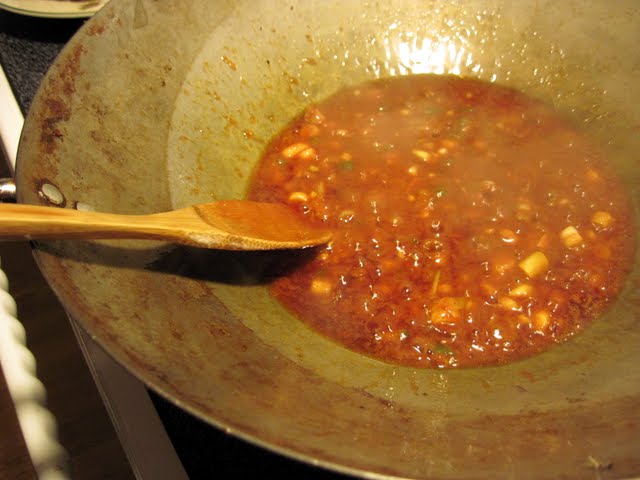
Drumsticks with Dates

There was only one time on this blog when I focused on perfecting a single dish, Tarte Tatin. And even then I was not so much attempting to perfect a single recipe as I was exploring variations thereof. I am habitually scattered. After Tarte Tatin it seems that where cooking is concerned I want to try many things, and not try, try again the same thing.

Hence while I have been cooking the same core ingredient (chicken drumsticks--they’re cheap) over and over recently, there has been very little work involved. I just try something different every time. What I try is largely dictated by what is around: lemons one day, cherry tomatoes another, and today, dates. The beauty of these things is transient. It lies in the coalescing of an improvisation into something that tastes good, miraculously. Subtlety and discernment are out of the picture. Those finer qualities only take form and may be tasted through repetition. But these dishes, unless they are a disaster, are the best thing at the moment they’re served. Very rarely do they happen again. Yet I write recipes for them.

5 chicken drumsticks
1/2 onion
1 small carrot
~15 pitted dates
juice of 1/2 lemon
1/2 cup water
2 tablespoons cooking oil
1/2 teaspoon cloves
2 teaspoons cinnamon
1/2 teaspoon black pepper
~1 teaspoon salt

Two hours ahead of time salt both sides of chicken drumsticks--a generous pinch for each side of each drumstick--and let sit on a plate to warm to room temperature. In a small bowl pour lemon juice over pitted dates, add cloves, cinnamon, and black pepper, and mix together with a spoon. Slice onion half in half against the grain, and then chop into small pieces with the grain. Slice carrot in half lengthwise and then chop both halves into small pieces. Set oven to 450 F. Oil a small square baking pan, place onions and carrots in the pan, and put it in the oven. In a large saucepan on medium-high heat with a bit of cooking oil, quickly brown both sides of drumsticks (this should only take a couple minutes per side). Move drumsticks and date-lemon-spice mixture to baking pan, mix everything together in pan, and let it continue to bake at 450 F. After twenty minutes, flip over drumsticks, stir vegetables, add 1/2 cup water, and continue baking. When drumsticks are done and the bottom of the pan has turned to a thick sauce, it is done.

Wednesday, February 16, 2011

Pantry Cleanse II: Quinoa and Kidney Beans

There are two things lurking in my pantry that have become staples in the last two weeks. I always cooked and ate them separately--quinoa as a kind of hot grain salad, and kidney beans as a thick soup. Today I decided to make a meal of combining the two.

This being a "pantry cleanse" (a term I've lifted from "life, in recipes"), all of the ingredients are incidental. Each has a particular history of how it ended up in the kitchen. Because my father has a tendency to buy food as if we are preparing for the end times, we have an entire case of canned kidney beans, and a giant bag of quinoa. There are those things that I habitually buy and see as necessities: onions, cooking oil, salt, chili powder. I bought the green onions because they were on sale and I thought they might encourage me to improvise. My brother and I got a yellow beet and carrots for a salad some time ago. I don’t remember why we had mushrooms and jalapenos--for some other meal. Inexplicably we have what to me is an enormous quantity of saffron. I really don’t know what to do with it. I put it in all sorts of things, thinking that I’ll taste it, but I don’t. Its subtle flavor eludes me. In imitation of some kind of aromatic rice dish, I used it in the quinoa, along with some cloves.

Incidental food is a topic that I have talked too much about, but I think insufficiently. Sure, there are recipes, like this one, that come about incidentally. But what I want to talk about is how it’s a deceiving accident of idiom that one makes food. What I want to say amounts, basically, to an “in Soviet Russia” joke: food makes you! There are several reasons for this. As much as the ingredient lists of some recipes would have us believe supermarkets are infinities of choice, there are in fact items that are not available. Foods are varying levels of affordable in different places. We are habituated to certain kinds of foods and preparation methods. And most importantly, food is woven into our social lives, our families, and our psychology. Maybe your mother tries to dictate what you eat. You may not necessary follow all or even any of her commands, but nonetheless your gustatory life becomes defined by them, by her. Maybe you live with your grandmother, and she only has certain scare items in the kitchen. Maybe your crazy landlord lives and sleeps in the kitchen, and you want to limit your time there as much as possible. Maybe you live at home with your father who impulsively buys an assortment of food that you feel compelled to use before it perishes. And maybe you’re a cheapskate and want to eat as much of the odd items laying around the kitchen as possible, buying only very little.

Nigella Lawson talks about culinary agency with a turn of phrase that I like, “greedy opportunism.” Of course there’s more than a little contrivance in her usage. Greedy opportunism is the process of gadding about in her shining kitchen picking out gourmet goodies that just happened to find their way there, and relishing some new use for them. It is as if she has an infestation of pantry-stocking gremlins. But while it is a class-charged way to frame her show, it’s also one way that improvisation in cooking happens: things you don’t necessarily have a planned use for will end up in your kitchen; use them somehow. At least half of what I cook is through greedy opportunism. Although I must admit that only rarely is it greedy.

Beans
2 12oz cans kidney beans
2/3 cup water
1 onion
4 mushrooms
1/2 carrot
1/4 yellow beet
1 clove garlic
1/2 jalapeno
1 tablespoon cooking oil
1/2 teaspoon chili powder
1/2 teaspoon salt

Chop onion 1cm square. Cut mushrooms in half and then slice finely. Julienne carrot into 1/2 inch long pieces. Chop beet, garlic, and jalapeno half finely. Fry all vegetables in cooking oil in a large saucepan on medium heat. Add salt and chili powder. Sautee for about twenty minutes, stirring every few minutes. Don't stir more often because the mushrooms won't brown. Stir in kidney beans and water. Bring to a boil and then remove from heat.

Please, please give me something
better to do with saffron.
Quinoa
1 cup quinoa
2 cups water
1/4 lemon
1/3 cup chopped green onions
1/4 teaspoon saffron threads
1/2 teaspoon salt
1/4 teaspoon powdered cloves or 4 whole cloves

Combine quinoa and water in a medium pot and and bring to a boil, covered. Remove from heat and add lemon quarter, green onions, saffron threads, salt, and cloves. Cover and simmer on medium-low heat until all the quinoa has absorbed all the water. Remove from heat, add salt, and mix to disperse seasonings.

Sunday, February 13, 2011

Gobi Manchurian

Post hoc ergo proptor hoc. That the fire occurred the morning after making it is not important. Gobi manchurian causes grease fires.

(The morning after is, after all, the more fiery moment.)

Non-Wheat Gobi Manchurian
(adapted from Sailu's Kitchen)

2 medium cauliflower heads

Breading
1 cup nonwheat biscuit mix
1 1/3 cup water
1/4 finely chopped jalapeno
1 teaspoon finely chopped ginger
1 large clove finely chopped garlic

Stir Fry
2 tablespoons sesame oil
the rest of the jalapeno, chopped
whites of several green onions, chopped
1 large clove garlic, finely chopped
1 teaspoon ginger, finely chopped

Sauce
4 teaspoons soy sauce
5 tablespoons tomato sauce
3 teaspoons vinegar
1 1/2 teaspoon brown sugar
1 teaspoon chili powder

Chop cauliflower into florets about 1 inch square. Soak florets in salt water. What does that mean? I used probably 3 teaspoons of salt. Who knows if it does anything. Finely chop jalapeno, ginger, and 2 cloves of garlic. In a large mixing bowl combine all breading ingredients. In a small bowl combine all sauce ingredients. Chop the whites of a bunch of green onions off and chop them into roughly 5mm pieces. Fill a wok about 3/4 inch with high-temperature oil. Heat oil to ~350 F, if you have a thermometer. Otherwise try heating it for five minutes, then test it every minute or two with a dollop of breading. It should bubble a lot, and brown fairly quickly. What specifically does that mean? I don't know. In any case drain the florets thoroughly and dump them into the bowl of breading batter. Mix them around until they're evenly coated.

Then deep fry as many as will fit in the oil at once. Turn them over with a very long utensil every couple minutes (the oil is not deep enough to fry them evenly). Break apart any that stick together with the same long utensil. Don't let them get cuddly. When they are golden brown (is anything ever not supposed to be golden brown when it's done?), take them out with the giant utensil, without taking too much oil with them, and put them on a paper-towel-covered plate. Repeat this paragraph until there are no more florets to fry.

Pour the oil into a very very dry container that will not die from the sudden heat. Then pour the sesame oil in the wok. Stir fry all the ingredients under, yes, you guessed it, the "Stir Fry" title. For a few minutes. I didn't do this. I forgot. I just put the stir fry ingredients in with the sauce. Which is next: pour the sauce into the wok. Stir it constantly for about five minutes. Add a few tablespoons of water, and let it come to a boil again. Then dump in all the deep-fried florets and coat them with the sauce. The question here is: to immediately remove them from heat, or to fry them in hopes of making them crispy? I went in between, frying them for only about a minute, and they came out soggy.


Sunday, February 6, 2011

Timing

Truthfully all the durations in my recipes are guestimates. When I say five minutes I just mean what felt like a short amount of time. I was not looking at the clock. I imagine this isn’t a surprise to anyone. Timing in cooking is vague and conditional, something sensed out and learned.

Despite knowing this about myself, it is sometimes easy for me to get take the numbers of minutes in someone else’s recipe as absolute. There are far too many variables that make this impossible. Even if the recipes were written from precise timings in the author’s kitchen, these do not necessarily or even often translate well into another kitchen. Ingredients differ, altitudes differ, pans differ, burners differ, etc. There is a complex if not always logical process of translation. Often what the recipe says marks the dish as done is more absolute than the cooking time. But those numbers are not useless. They might tell me that something is different. If the recipe says 45 minutes and the cake has been in for an hour and still doesn’t look done, then something is different, even though what exactly is the work of sketchy reasoning.

Either improvised or from a recipe, cooking involves for me a great deal of anxiety about how long to cook something. The worst are the things I can’t taste for doneness, like baked goods or roast chicken. Or tea, which I rigidly time but am always wondering if I should leave the leaves in longer or take them out early. Even when I cook something as simple as sauteed vegetables I go to the pan every two minutes to taste how soft they are, and am constantly uncertain if they’re soft enough or too soft. It’s not really two minutes, it’s more like I’ll take it off the burner when I’m done reading a blog post, after I feed the dogs, after I go to the bathroom, after I finish doing the dishes, etc.

The clock, in other words, is a deceptive ally to cooking. It deludes cooks into false certainties that assume the kitchen is the same as the mechanical innards of a clock. Timing, on the other hand, is essential.

Sunday, January 23, 2011

Inedibles: Beet Cake and Boiled Turnip

As a certain song would put it: what is a cake with no one to eat it? I have complained, I have belittled, and I have relativized, but never* have I written on this blog about something I cooked and refused to eat.  How does one deal with inedible food, and just what is meant by ‘inedible’?

I began composing this entry before I made the beet cake. Specifically I planned to write that I began composing the entry before I baked or ate the beet cake that the entry was to be about. I was supposed to then connect this fact to the idea that I tasted the cake before I tasted it--an idea I have been developing (or perhaps only reiterating) in recent entries. But instead the real cake completely collapsed the cake I had imagined (in addition to itself physically collapsing). It went against my expectations in the most extreme way. I couldn’t even manage to eat more than a bite.

The photo from When Mia Cooks
After the last time I wrote about beets I googled beet cake, and, really, just looked for the most appealing images. The photo of uncooked batter in one recipe looked incredible: bright pink. Although the interior of the cake is hidden in all of the photos (all are taken from directly above the item), I suspect that it was in fact cake, and not whatever substance my ‘cake’ turned out to be.  Of course I didn’t exactly follow the recipe. My most egregious mistake, I think, was not measuring the amount of beets while following the measurements of everything else (eggs, flour, baking powder). But who knows. Now I want to write a recipe for something not at all appealing or expected, but photographs well. Watch out for that one. (Not that I imagine anyone is following any of the recipes I post.)

In preparation to be blogged, the process of creating the cake was photo-documented in detail. You can see the beets being boiled whole, releasing their wine-colored dye into the water. For some reason I decided that, contrary to the recipes I had read, I needed to boil the beets and puree them in a food processor rather than grate them into the cake batter. You can see the deep violet (even violent violet) batter, and the pink frosting. I reserved and then reduced the dyed water that the beets were boiled in, and used this liquid in the buttercream frosting. The reduced liquid had an overpowering taste, but the frosting was both delicious and pretty. You can see that the ‘cake’ that came out of the oven even looked like a cake on the outside, just like the photos from the recipe I didn’t follow. But look inside to see the strange, soggy result. It might be best described as beet puree with other things in it, as opposed to cake with beet puree in it.

What you can’t see is that I deliberately omitted sugar from the cake. I wanted to see how sweet a cake only sweetened with beets could be. Also I was motivated by the beet mythology that I established earlier.  The beets, I thought, should not be corrupted by their inferior cousin, sugar. My plan was to keep the sugar separate, to load enough sugar into the frosting that the cake would be sweet enough yet the beets would still remain beets. In the end omitting sugar from the cake only made it more disgusting than its texture did already.

Earlier I wrote of beets as an antithesis to taste in relation. I treated beets as a taste singularity around which language strains to find adequate comparisons. What happens when a singularity is baked into a cake? It intervenes. 

When I was carrying them home, the beets stained a library book I had in the same bag. One more beet just fell out of my bag. I had no idea it was still there, lurking.

It wasn’t just the beet cake that was inedible. Mashed turnip too. I assume this is the work of the beet. However I would also be willing to believe, given the legends surrounding mandrake root, that all roots are malevolently disposed. I had never tried turnips before. One reader pointed out that the turnip I boiled and mashed may not have been ripe. Do turnips ripen? “Doesn’t everything ripen?”

I feel obligated to describe how the turnip was inedible. I’ll go about this in a roundabout way by describing the anxieties that the guide to cooking turnips I found online gave me. While not explicitly saying so, the guide gave the impression that the turnip is a toxic vegetable, similar to, say, cassava. It warned that “turnips tend to have a bitter flavor if not boiled long enough, with at least ONE water change (usually two)!!” I had to extract the bitterness from them by changing the water, twice? Moreover for larger (and therefore more bitter) turnips “it is best to cook them uncovered so the bitter gasses can escape.” They have gasses? What was I trying to do, exorcise a possessed vegetable? If so I was not successful. The cooked turnip smelled nice, but I could not stomach it. It was not an immediate bitterness; it twisted slowly in my mouth, making all food distasteful for the rest of the evening. It was something evil. But I’m willing to believe that the evil can be more completely beaten out the turnip, if not entirely, and that the result would be tasty.

I was going to write about the (im)possibility of taste independent of other tastes. This was brought about by the realization that my writing usually peters out into thematic dissonance. Themes may be dissonant, but can they have no relation to one another? Can tastes? Circumstances changed , but I could have just the same written about bad taste (in)dependent of other bad tastes, or good tastes. I could have tried to answer the inane question: does the turnip I didn’t eat constitute a singularity of inedibility?

It turns out this was not an entry concerned with the ontology of inedibles. Instead I wrote a great deal about how the inedibles were cooked, and how they tasted. Their specific visceralness blinds me to the social construction of inedibility waiting just beyond the immediate “ew.”

* Except on one occasion.

Friday, December 31, 2010

What I Really Eat

Eggs on toast and a cup of ginger tea is far too often
my breakfast.  Gosh, now that I'm writing about it,
it sounds nice.
Making gorgeous tarts and experimental sauces is all well and good, but what do you eat for lunch on a hectic day, for instance?  How about breakfast when your eyes seem to have retreated permanently into your skull?  What gets you through the days, presuming that nobody cooks for you and you haven't the money to go out?

I'm jobless, so my day-to-day food is still a little ambitious.  As in I might use the stove in addition to the microwave or the toaster.  No cooking at all is also a possibility, of course.  Recently for lunch I have been, rather than a dish per se, just throwing together three or four things that take a minimum of effort and not much time.  Most of the time this involves leftovers.

Mundane food would be strange to write recipes for.  It's creation is entirely circumstantial.  Unless you're the sort of person who plans all of your meals and meticulously buys only ingredients for use in your meals.  Personally I find life to be far messier, especially sharing food with who I live with.  Today my lunch was miso soup, a grilled cheese sandwich, and a pear.  Why?  Because miso, bread, cheese, and pears were around.  But someone else would have done something else with these same things.  My lunch was both circumstantial and idiomatic.  It would be silly to write a recipe because making these things is not particularly complicated nor desirable, and because they came out of a very particular situation.  Then again taking food in and out of different contexts is what recipes do.  Just because this context is not the pristine dream world of a culinary superstar and the food is not the subject of superlative praise does not make it pointless to share.  I guess.  Sharing is one thing, but a recipe?  Really?  Whatever.

The truth is, I didn't eat the pear.  It just sounded like what should have gone with it.

Saturday, December 4, 2010

Something You Really Shouldn't Make, and Something Else, Which Requires The First

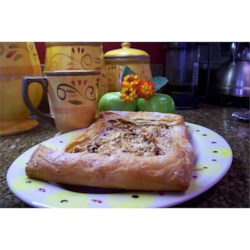
The photo I saw on allrecipes.
1. Looking for a way to use four granny smith apples, I was going to try to make "easy apple strudel," which more or less amounts to surrounding apple slices with puff pastry and baking it.  Unable to find puff pastry in the store, I bought phyllo dough instead, thinking that surely I could use this for something involving apples.  The something I stumbled into on allrecipes was also a "strudel," and seemed to function upon a principle of turning phyllo into puff pastry by layering butter between each sheet.  That, it turned out, was a very optimistic reading of the author's thought process.  Granted, I didn't follow the recipe exactly.  The gist seemed to be: layer about eight sheets of phyllo with melted butter in a pan, then put some apples, sugar, and whatever else you want on top of it, and then... and then what?  Here the text of the recipe says one thing, while the photo clearly shows something quite different.  The recipe reads "roll the sheets up to form a log shape."  The photo looks more like the edges were rolled up to prevent juices from spilling out.  For reasons somewhat murky to me, I went for the photo.  It occurs to me now that anyone can submit a photo for a recipe on allrecipes.  Food photography incites a strong mimetic impulse, but here the assumption that the photos accompanying a recipe come from the author's execution of the recipe, filling out the vagaries that the recipe's words have left, is wrong.  In this case the photo is of someone else's (mis)execution of the recipe.  Allrecipes is thus where a recipe's signified is set adrift.

The web 2.0 mechanism has wide limits, but of course there are plenty of other instances of dissonance between a recipe and its accompanying photography.  In those lavish coffee table cookbooks filled with beautiful photos that take up whole pages, the recipes often lack the finishing touches that made them look so good in the first place.  I have this Thai cookbook that mostly consists of photos of the countryside and its people living a far more aesthetic life than anyone possibly could.  In all the photos the dishes have these amazing garnishes, are placed on rustic tableware, and sometimes even contain ingredients that aren't in the recipe.  What draws me to make a particular recipe in the book is of course the photo, but not only is the recipe inadequate--it is impossible to recreate the photo unless you live in a fantasy version of Thailand.  In other words, rather than follow the recipe, you're better off going to a very upscale Thai restaurant in the US.  Yet if you do follow the recipe, it will be a medium through which to experience the photo.  Though you can see that your dish is not as it is pictured in the book, you taste the photo.

My version.
In the case of this "strudel," the photo fantasy backfired: tasting what I made didn't confirm that my version pales in comparison to the pictured, but rather it told me that what was pictured wasn't that great. It tasted about like it looked--okay.  The phyllo at the edges curled up and turned crunchy, which was mostly just annoying.  I ended up scraping most of the excess flakes off before putting a piece on a plate.    The bottom crust was far too tough, making it difficult to eat with a fork, as well as being an unpleasant texture.  The filling at least was nice: tangy, sweet, and cooked just right (the apples were neither mush nor crisp).

2. As a result of the above debacle, I now had a lot of browned phyllo flakes.  Rather than throw them away, I decided to turn them into a sort of bread pudding.  The pudding came out much better than the original "strudel" I think.  What follows is a very rough recipe, as I wasn't really measuring anything.

~2 cups phyllo flakes (I tore up some uncooked phyllo too)
2 eggs
~2/3 cup milk
~1/2 cup sugar
~2 tablespoons honey
~2 teaspoons cinnamon
~1 teaspoon nutmeg
a few drops of vanilla
~1 cup chopped almonds
~1/2 cup raisins

Preheat oven to 350 F.  In a bowl whisk together eggs, milk, sugar, honey (heat in a microwave first), cinnamon, nutmeg, and vanilla.  In a 8x8 baking pan, toss phyllo flakes, chopped almonds, and raisins.  Pour wet mixture over dry mixture.  Bake until the whole thing puffs up--maybe half an hour.

Sunday, November 21, 2010

Principles of Economy

A friend of mine found this strange recipe in The Sherlock Holmes cookbook: Or, Mrs. Hudson's storeside campanion formed upon principles of economy and adapted to the use of private families:

3 tbsp Butter
3/4 lb flour
6 oz sugar
1 grated lemon rind and lemon juice
2 eggs

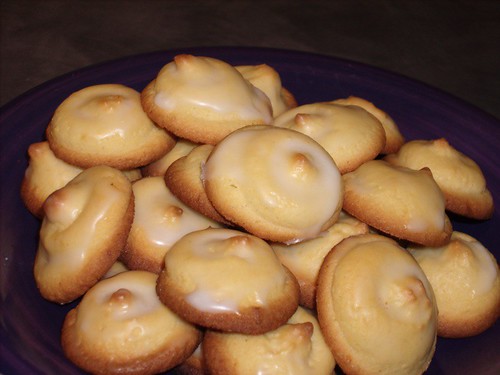
Rub the butter into the flour; stir in the sugar and the lemon peel. When these ingredients are mixed, add the eggs and lemon juice. Beat the mixture well for a few minutes, then drop from a spoon onto a buttered baking sheet, about 2 inches apart. Bake the biscuits from 15-20 minutes in a moderate (350F) oven, until they lightly brown.


Who measures sugar by weight?  To me 6 oz seems like it isn't much at all.  The small amount of butter and sugar makes me want to classify these as a tea biscuit--something fairly bland but somewhat sweet.  But then there are the two eggs.  Two, for this little batch of dough?  They're bound to come out like dry, dense cakes (no rising agent here).  Who knows.

I doubt they'll look like these.
They appear to be a sorrier version of these very appetizing-looking "Mrs. Hudson's Biscuits."

Bored, and intrigued by the possibility that making these "biscuits" might surprise me, I think I'll make them tomorrow.  I'm tempted to take the literal approach and actually rub the butter with my fingers into the flour (something i've never done), rather than cut it in with a fork or a pastry blender.

Saturday, November 20, 2010

Sweet Potato Pie

I made sweet potato pie.  I followed the recipe from the first google hit for "sweet potato pie," with some alterations.

Is this worth writing about?

I made some very broad statements in the last post, as I'm wont to do.  While I was making the crust for the pie, I kept having to look back at the recipe I adapted from Helen Rennie to remember quantities.  Despite making pastry dough many times, I needed that recipe.  Or at least I needed its list of quantities.  The recipe is not disposable.  It's a kind of helper--somewhere to defer my memory.  It's an instance of a cliche of how the internet has changed the nature of knowledge: it's not so important if one remembers everything, so long as one knows where to look.  In the case of recipes however, the internet is not necessary at all--encyclopedic cookbooks have been serving as cyborg extensions of memory for a long time.

So I don't need to know how to make pastry dough.  I wrote it here in this blog.  The blog remembers how.  To return to my question, is this worth writing, let's compare this to my diaries.  I have boxes and boxes of diaries.  Most of them I have read at least twice.  Reading them is at once familiar and surprising--on the one hand, reading them triggers memories and I might also recall writing what I wrote, on the other, I had, up until reading it, forgotten much if not all of what I wrote.  One is almost always remembering in one way or another, but there is obviously nothing cumulative about it.  Reading a diary doesn't add to a collection of things I remember, but puts me in a different stream of remembering.  Through reading the diary some memories come to life again--I think about them again briefly, they might crop up over and over for a long time.  In other words, the diary must be read, and reading happens in time.  Having "saved" (the anxiety of losing memories drove much of my diary writing) these memories in a diary, only in the unread text of the diary might they be saved.  Only without a reader might the text be said to exist as a totality.  But not really, of course--it isn't anything without being read, is it?

But this blog is not a diary.  I'm not trying to record the ephemera of experience here.  A recipe is simply supposed to record a procedure in a way that's followable.  Actually this isn't so simple, as I've discussed before.  And thankfully.  Wouldn't it be awfully dull if even just a recipe could be written in the universal register?  This suggests another purpose for a recipe: to not be quite followable.  Not that a recipe writer has to try to do this, but a recipe's potential to confuse, mystify, or unintentionally inspire might be valued.  Because apparently I need to subject recipes to the literary theories of decades ago.

The pie was good.  The crust I thought was a bit too hard, although someone else liked it, called it "crunchy."  I prebaked the crust for fifteen minutes or so before filling it, using the sweet potato pieces in tinfoil as a weight to keep the crust from puffing up.  Improvising a weight was the most enjoyable part.  Next time however I'll just fill the unbaked crust, so that the crust turns out softer.

Thursday, November 18, 2010

Ate My Soul and Gave Me The Recipe


As we discussed earlier, dear nonexistant readers, the ostensible purpose of a recipe is to facilitate recreations of the same result.  But of course this is not the whole story.  When you’re most in need of a recipe is when you’ve never made what the recipe tells you how to make.  At such a delicate time you take care to follow the recipe exactly.  Having never followed the recipe before, it is easy to misunderstand the recipe.  Sometimes, by sheer luck, the first time comes out flawlessly.  More often there are some kinks, which over the next few attempts, are worked out, and finally a satisfactory result is produced.  After this point, if you need the recipe at all any more, it is more as a memory map than an instruction set.


What is it you have created?  Your creation conforms to the limited contours that the recipe provides.  If you were after a replica of what the author sought to instruct you to make, however, there is no way of confirming this.  Sometimes there are photos, which often provide a more forceful impulse than the recipe itself--you see the photo and think “I want to make that.”  It’s sometimes easy to make it look right, sometimes it isn’t.

All these masturbatory, death-of-the-chef preoccupations aside, whether or not the recipe changes, you change.  At least, this is one way of accounting for culinary disappointments.  Tonight I made pasta with tomato-cream sauce and shrimp for dinner, and I ate it, but only because I was hungry.  The flavors were weak, and the textures even a little nauseating.  I’ve made pasta with tomato-cream sauce in countless different ways, some less satisfying than others.  And I keep making some form of it because I remember a few delicious instances of this dish.  But this time it’s been long enough I wonder if I have any idea what I’m after.  If I made what to me was a wonderful pasta dish a year ago, and ate it today, would I like it much?  There really isn’t any way of finding out empirically.  If I wrote down the precise recipe for those times when I made a particularly spectacular rendition, I doubt I would be able to reliably cook it again.  And I doubt I would want to.

A recipe is a much more intriguing beast than it may have appeared.


The general shape inconsistently described above also applies to me writing this entry.  Through writing, what I wanted to write changed.  What I thought I was writing changed.  These changes can hardly be tracked by the writing itself to create something coherent.  To me it appears that throughout the entry I forgot what I meant to write, and began on a new, somewhat related tangent.  By the end forgot the import of everything I had just written, summing it up as "intriguing."

Thursday, November 11, 2010

Bizcochuelo de Papa


I had forgotten about Olga de Trejos' La Cocina Practica. This ardently mundane title resurfaced in a--no, the: I haven't done it in five years or more--thorough cleaning of my room. I think the fact that it's in Spanish, a language I more or less understand but am not very comfortable speaking has a great deal to do with my conviction that there is something to be found in this book. In it's range of recipes it is The Joy of Cooking, but unlike Joy it is more concerned with nutrition facts than technique, and rather than outlining recipes in painstaking specificity, de Trejos, with her exceedingly short recipes, seems to assume you know what she's talking about. Not knowing, in my case, is compounded by the fact that Spanish is not my native tongue. However most of the recipes are nonetheless very recognizable. The book seems to be for the most part (and here's the resemblance to Joy) a convenient anthology of European-derived classics.

So I'm fascinated by a dessert I've never ever heard of: Bizcochuelo de Papa, or, in rough English translation, Potato Cake.

1 libra de papas
6 huevos
9 cucharadas de azúcar refinado
jugo de 1 limón y cáscara rallada

Se hace un puré con las papas bien calientes para que quede espumoso. Se le agrega el jugo de limón, la cáscara rallada y las 6 yemas bien batidas, con el azúcar. Se baten las claras a punto de nieve y se incorporan suavemente a la mescla anterior. Se coloca en un molde engrasado, se espolvorea con azúcar refinado y se hornea a calor moderado.

Nasty lightining isn't it?
At first, having no idea what bizcochuelo meant, I thought it was a kind of potato pudding, because of the large quantity of eggs. The eggs are separated and the whites are beaten into frothy peaks. I like the spanish metaphor for this: one beats them "a punto de nieve"--"to the point of snow" or "into snow." The beaten egg whites, in my mind, make it a kind of angel food cake, but with potatoes. Why use potatoes in a dessert? The exotic imagination boggles.

My bad English translation of the recipe:

1 pound of potatoes
6 eggs
9 tablespoons sugar
juice of 1 lemon and its zest

Make a pure with the hot potatoes so that they stay fresh (sparkling? in spanish espumoso) Mix in the lemon juice, zest and the six egg yolks, beaten well with the sugar. Beat the egg whites to high peaks and fold in the yolk-potato mixture. Put in a greased mold and sprinkle with sugar and bake to a golden brown.

Yes, you have to see three photos of potatoes.

You might notice there is no oven temperature, or, for that matter, baking time. Nor is any shape or size of baking mold specified. But what I really love is the way the recipe begins in the middle of the action. Never mind how the potatoes are cooked, or even if they're cooked--just puree them when they're hot, so that they remain... what? Perhaps someone could help me out with what espumoso means here?

Not nearly yellow enough.
I decided to try it anyway, making the following assumptions: the potatoes would be boiled and mashed without any of the water, the baking temperature would be 350 F, and the baking pan would be whatever I had that seems about the right size to accommodate the batter.

My friend who agreed to join me in this endeavor (as in to make another version and tell me about it) commented that it seems like a lot of eggs for not very much potato. I agree, but when I began mixing it together it began to make sense: the potato paste is very dry, and the six yolks are just enough. Well, five might do.


This, as well, was more yellow.  And on the right side.


The result was something very nothing--pleasant and delicate. The metaphysical implications of describing it as “very nothing” are familiarly appalling, but. Why not give (or allow) it a bit of fruit and/or a glaze? Doesn't this little cake look sad and alone?

PS I just realized that's calor moderado not color moderado. So the recipe does specify oven temperature, albeit vaguely, but not how to tell when it's done.

Sunday, October 24, 2010

Tarte Tatin III: Golden, Delicious, Boring

This time I used Golden Delicious apples.
Look, no applesauce!
4 apples, 6 minutes caramelizing, all-purpose flour.


Having put together a satisfactory result (I've replicated the more blonde photos that appear if you search for "Tarte Tatin" on Google Images), what would be the purpose of writing another recipe?  The trail-and-error experimentation I went through to arrive at this tasty yet now boring tart was not because of a dearth of good recipes, but rather because I had to get to know the recipe.  Apparently getting to know a recipe, for me, involves significant variations that are clearly not called for in the recipe: different fruit, sugar, flour, and proportions. (If stupidity is doing the same thing and expecting different result, what is doing something different and expecting the same result?)  It was through this daft variation that the necessities of the recipe revealed themselves.  Pears instead of apples and honey instead of sugar are fine.  But whole wheat pastry flour makes more finicky dough than all-purpose flour, the type of apples is dramatically important where consistency is concerned, and caramelization is a highly sensitive process that if you're niggly about burnt spots requires stirring, flipping, and paranoia about how long to leave the pan on high heat.  And so several seemingly unimportant details, glossed over by most recipes, become solidified into details that must happen.  If knowledge is as I have just described it, a collection of immobile things, perhaps this is why I am not at all motivated to write another recipe now that I think I know what I'm doing where this tart is concerned.  The previous recipe was in pursuit, and we've all heard those sayings about how it's all in the chase.  It was a recipe of what I imagined should be done, an imaginative fiction of sorts.  This recipe that I feel I should but don't want to write would be a history.  Although I would make some minor changes: I would caramelize it for just a little longer.  I would make sure there isn't a gap in the arrangement of apple slices.  I would use a little less water in the dough (the crust was a bit tough).  I suppose the point of writing the recipe down would be as an elaborate mimetic.  Months or years from now I will have forgotten about all this, and the recipe should allow me to make the same tart again, even though without the recipe I won't remember how.

Well, I still have one more round of dough in the fridge.  I'll write the recipe after I make one more tart.

Thursday, October 1, 2009

Chop sentences well. Pour 3 qts. superfluous detail into lightly greased shorthand.

The economy of recipe grammar that I've been working within is really baffling. Articles must be dropped, but the most obvious steps must be pinned down with the utmost exactitude. And the continuity of labels is sacred, as if I'm writing in a programming language.

Also, what was all the fuss about numbers as words instead of numerals? The idea at first was to make these recipes as transparent as possible, though I sabotaged that supposed goal at every turn, writing "one" instead of "1" was just one way to do that. The first recipe, for lentil soup, appears to be making itself as opaque as possible by making a spectacle of its potential transparency. Really that's what I love doing anyway. The point, apparently, is not to write accessible recipes, but to make a show of it, to be dramatic, to reveal myself hiding.