Showing posts with label tarte tatin. Show all posts

Friday, March 18, 2011

A Particularly Rough Day in the Life of a Saucepan

Sometimes, I wish I could taste. Almost every day I'm filled with substances that my owners find flavorful. And sometimes I imagine what it would be like to be them. But I know that it is their place to taste, and mine to hold and to heat. Well, no, I don't actually heat--something else heats me and I heat the things my owners eat.

I have my good days, and I have my bad days. It's hard to know which are which. There are the days I luxuriate in the darkness of the cupboard, and days I reach a several hundred degrees, containing fireworks of oil and water within my walls. Of course, there are those times I'm left in the sink filled with grime and water for hours or days.

Today was nuts. I was not in the sink an hour before being scraped clean in a rush and thrown back onto the heat. It takes some time for me to warm up. My owner threw slabs of butter onto my surface, and I turned them to golden puddles. I don't normally melt butter at this temperature. It was bit invigorating. Sugar weighed down on me. This is why I'm made of metal, and not, say, paper. A paste of sugar and butter scraped me like sand as he mixed it. But it takes something much worse than sugar to actually scratch me.

There were apples, too. It all became molten soon enough. Wet apples clung to my surface and, cringing, I burnt them. At such moments I feel a pang of regret and anger at myself or at my owner, I can't say which. It is his neglect but my flesh. I got the feeling he was being especially negligent today, because rather than carefully maintaining the arrangement of apple pieces held within me, the spatula was flung every which way as he mixed them into a messy pile. Beside me I heard the frantic motions of a rolling pin. It did not take long for the molten sugar to begin to burn. There is something in the way it bubbles that gives it away. Atop me he threw brown scraps of dough like the ad-hoc furs of some barbarian. Most of the gaps were closed before I was thrown in the oven.

Waiting in the oven is different than the usual kinds of waiting I do--waiting in the cupboard, waiting in the sink--because, like him outside in the kitchen, I am anticipating being removed from the oven. In the cupboard and in the sink I don't get so anxious because I know I could be there for a long time. I'm never in the oven for very long, though I never know exactly how long. I keep wondering if the crust is browned enough, if he will be satisfied with how the crust looks. He opened the oven at least a dozen times during my stint in the oven this time.

When he finally did take me out, he ran a knife along my walls, as he usually does, to detach the crust. I do wish he would find a better way to flip me over. It makes me nervous being spun about like that, although honestly at some level I hope he does slip, drop everything including me (I'm metal, I can take it), and spill burning tart all over him. But yet again, he didn't. He did burn himself on my handle though. I suppose you could say I burned him. But really, he should've known better. I wonder why he's so clumsy today.

Like I said, just a quick scrub and I was put back at it.


As the ripping sounds of vegetables being sliced apart reverberated through my metal curvature, I became increasingly hot. Oil slipped across me, pooling on one side. This is why I have walls. My owner dropped the sliced vegetables onto me, and I made them sizzle. I could feel them slumping and sweating against me. What does a shallot taste like? A heap of broccoli interrupted my speculations. He didn't let the shallots develop their flavor, he was hasty. He usually leaves onions, which are similar enough to shallots, sauteeing for much longer. He was acting strangely.

The vinegar and olive brine barely touched me, becoming puffs of steam on contact. He covered me up, trapping clouds in my interior. Water collected in droplets inside my cover, and streamed down the sides. More water was splashed in from a cup, and more. Vapour spat out my sides.

The flour he sprinkled in just turned to tiny lumps. My task was basically done, then just a container into which more was dumped: shrimp, salt, pasta. For a moment he slides me back onto the heat, but takes me off again. That's it. I've been left in the fridge ever since. I'm used to waiting.

Tuesday, March 1, 2011

Scraping the Bottom of the Barrel: Photos

Beets and Parsnips.

Beets and Parsnips, roasted. Ugh, what a phase.

One of the many pear tarts that never made it here. Or maybe this one was apple?

One of the strangest meals. Those two white patties are ground turkey with egg, flour, chiles, garlic, onion, and... some other stuff, possibly. Those are just boiled potatoes to the right. The sauce, really, was the tasty part: spicy brown butter sage cream sauce.

What happened to the beet frosting? It frosted a nonwheat spice cake.

A biscuit made entirely with yogurt for liquid. Yogurt had the effect of keeping it a little too moist. It was also very dense.

Collard green stems with olive oil, garlic, paprika, and red wine vinegar.

Using wikipedia as a guide, stir-frying is my favorite thing these days. This red cabbage and bok choy was stir-fried with soy sauce, lemon juice, brown sugar, hot sauce, garlic, ginger, and sesame oil. That omelete is yellow, isn't it?

Monday, December 27, 2010

Taste


What makes a good tarte tatin? Going by the polite compliments of those who consumed the pear-ginger tarte tatin I made for Christmas dinner, my quibbles are excessive. Soggy crust does not matter. The way the butter rose to the top to form an off-white opacity does not matter. Hell, those things didn’t matter to me, either. I only wanted there to be more of it. Yet a sense of culinary aesthetics demands that the pears should not be laying in a pool of liquid when the tart is turned out onto a dish. (Maybe this could be avoided by using sugar instead of honey.)

There is also a sense that the making makes the dish, a conflation of the process with the result. The logic goes if I’m pleased with the pears boiling in honey--if it looks good, if it smells good--then the tart is good. This also goes for the sweet potato pie I made the same day. I liked its color (a bilious drab green), and what went into it. The light spices, the light sweetening of honey, the light color of the Japanese yam flesh, the thickness of the pie all came together in an aestheticism that had nothing to do with taste and yet constitutes a great part of taste. When I tasted it, it was the beauty of the process I was wishing for.

This is why it is necessary but impossible to separate taste from aesthetics, pleasure from ideas. Necessary because taste does not come of itself, and impossible for the same reason.

I might account for my former enthusiasm for the dozens of dense, eggy spice cakes by remembering my enjoyment of what went into them. There was a subtle balancing art of ingredients and spices that went into these cakes that was impossible to discern in the finished product unless you were me. It was possible for me to taste some hidden nobility in the cake despite the consistency which I could somehow deny. More likely I only now, several years later, remember them as dense and disgusting, and at the time there were not other possibilities that I knew of.

In honor of the cooking process’s interiority (if not the cook’s) rather than its ultimate appearance as taste to the world, the accompanying photos are of pear peels, pears boiling in honey, and unbaked sweet potato pie.

Excuse me.  Instead of "in honor of," the paragraph above should begin "to exploit," much like speeches that "honor" the dead.


Monday, November 29, 2010

Picture Show: Soggy Pear-Ginger Tarte Tatin


Three D'Anjou (one of which is unripe), and one Comice.  More a compulsion than a desire for the end result.

Ginger in butter.  Ginger was not something I wanted to taste in the tart at this point.  It didn't smell right.  Adding it to the tart was just something I wanted to do.

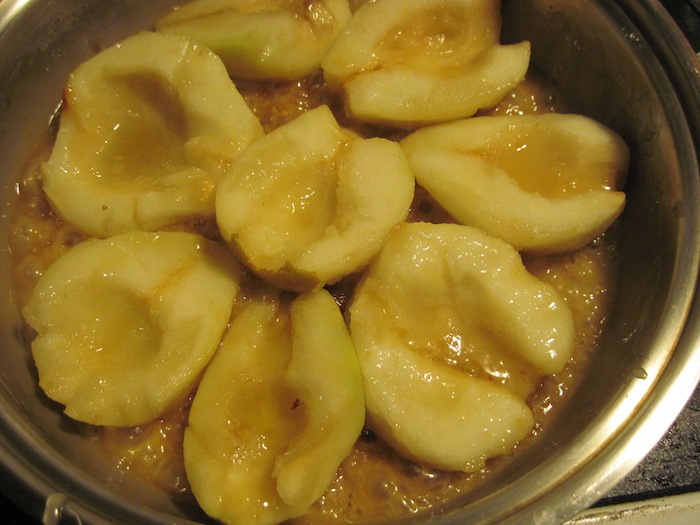
Boiling sugar before it begins to brown.  The pear on the right is awfully green.  It won't taste like much of anything, but it will make the tart look right, have the right proportions.

Rolled out pastry with a patch.

At this point I removed the pan from the heat.  The Comice is the larger halves.

Because you need before and after photos of the crust.

The brown juice on the edges?  Much of it spilled off the side of the plate when I inverted it from the pan to the plate.

Despite this, the tart, I suspect because of the Comice, was soggy.  But it looks good, don't you think?

Saturday, November 27, 2010

Thanksgiving is not a Great Art

This being a cooking blog, some sort of Thanksgiving post is probably expected. I was going to do one, actually, as I was planning on making pear-ginger tarte tatin. But the pears weren't ripe yet, so I made sweet potato pies again. The pies were good, but was there really anything to say about them? The scope of this blog has mostly only included deliberate experiments (or trying new recipes), and sometimes brief recipes of particularly good improvisations. But in fact "particularly good" is not at all the criterion for which improvised dishes or meals get written here and which don't. There are no criteria really, I just post when I feel like it. Some of the most well-remembered meals, usually those that were made to feed to my family, I never write down at all.

How are these statements connected?
"I'm very nervous when people talk about it as a great art."
"There's a lot to be said for mindless repetitive activity."
"It does not interest me if I'm not feeding people."
Well, Nigella Lawson said all of them. In the same interview she said she was unfazed "when How to Be a Domestic Goddess came out and I was railed against for being, you know, a traitor to the sisterhood, despite the fact that it was so obviously ironic."  Apparently Nigella expects we all share her level of self-consciousness in the nostalgia for domesticity she purveys.

Her story of how she started: when she was working as a journalist, she found space to think in the repetitive activities of cooking.  Making food, rather than a necessity, was in her story a psychological tool and a lifestyle choice.  Instead of feeding people because she's a housewife, she seems to self-consciously enjoy the fantasies that surrounded housewifery.  But obviously this is not the selfless fantasy of classic femininity.  One cooks for the pleasure of feeding, including the pleasure of feeding oneself.  One returns from an exhausting night of partying to make oneself bread pudding in the semidarkness of one's posh kitchen, and one eats it, alone, in bed.  If one is Nigella Lawson, one stages all this on camera and, I imagine, laughs about it.  What makes her so passionate about food, she is asked?  "I'm greedy."

This blog, on the other hand, is more about curiosity than greed or giving.  Although in trying new techniques and recipes, I often take part in a bit of both these pleasures.

Tuesday, October 26, 2010

Tarte Tatin IV: Reproducibility

~10'' saucepan
4 Golden Delicious apples
1/2 cup honey
2/3 stick butter
1 tsp lemon juice
pastry dough enough to cover the ~10'' pan rolled

Preheat oven to 375 F.  On low heat, melt butter in saucepan.  Fill a large bowl about half way with water, and pour in lemon juice.  Peel, core, and quarter apples, placing them in lemon water.  When butter is melted, remove pan from heat and stir in honey, mixing thoroughly (a rubber spatula works to both stir and scrape honey out of a measuring cup).  Shaking off excess water, arrange apple quarters radially, exteriors up, in pan.  (Arranging the outside edge first is easier.)  Roll out pastry into a roughly round shape large enough to completely cover pan.  On high heat bring honey-butter to a boil.  Boil for 3 minutes.  Flip apple quarters. Boil for another 4 minutes, stirring apple quarters around but not messing up their arrangement (pushing the outside edge to spin it and moving the pan in a horizontal, circular motion are two ways to do this).  Remove from heat.  Move the rolled out pastry dough using rolling pin, and place evenly on top of pan.  Trim excess if there is a lot of it.  Using a utensil to avoid burning hands, gently tuck the edges down between apples and the edge of the pan.  Gently press the top into a relatively even shape.  Bake for ~30 minutes at 375 F.  Cool for ten minutes.  Run a knife along the inside edge of the pan.  Using potholders, turn out onto a plate.  Cool for another twenty minutes.

(No I'm not posting another pastry dough recipe.)

Sunday, October 24, 2010

Tarte Tatin III: Golden, Delicious, Boring

This time I used Golden Delicious apples.
Look, no applesauce!
4 apples, 6 minutes caramelizing, all-purpose flour.


Having put together a satisfactory result (I've replicated the more blonde photos that appear if you search for "Tarte Tatin" on Google Images), what would be the purpose of writing another recipe?  The trail-and-error experimentation I went through to arrive at this tasty yet now boring tart was not because of a dearth of good recipes, but rather because I had to get to know the recipe.  Apparently getting to know a recipe, for me, involves significant variations that are clearly not called for in the recipe: different fruit, sugar, flour, and proportions. (If stupidity is doing the same thing and expecting different result, what is doing something different and expecting the same result?)  It was through this daft variation that the necessities of the recipe revealed themselves.  Pears instead of apples and honey instead of sugar are fine.  But whole wheat pastry flour makes more finicky dough than all-purpose flour, the type of apples is dramatically important where consistency is concerned, and caramelization is a highly sensitive process that if you're niggly about burnt spots requires stirring, flipping, and paranoia about how long to leave the pan on high heat.  And so several seemingly unimportant details, glossed over by most recipes, become solidified into details that must happen.  If knowledge is as I have just described it, a collection of immobile things, perhaps this is why I am not at all motivated to write another recipe now that I think I know what I'm doing where this tart is concerned.  The previous recipe was in pursuit, and we've all heard those sayings about how it's all in the chase.  It was a recipe of what I imagined should be done, an imaginative fiction of sorts.  This recipe that I feel I should but don't want to write would be a history.  Although I would make some minor changes: I would caramelize it for just a little longer.  I would make sure there isn't a gap in the arrangement of apple slices.  I would use a little less water in the dough (the crust was a bit tough).  I suppose the point of writing the recipe down would be as an elaborate mimetic.  Months or years from now I will have forgotten about all this, and the recipe should allow me to make the same tart again, even though without the recipe I won't remember how.

Well, I still have one more round of dough in the fridge.  I'll write the recipe after I make one more tart.

Thursday, October 21, 2010

Tarte Tatin II: Applesauce

The bits that were too burnt are on that little plate in the background.
 I followed the recipe I wrote last time, but with apples instead of pears.  But they were Granny Smith apples, and so the result is very thick, sweetened, somewhat caramelized applesauce on top of pastry.  It doesn't taste bad, in fact it tastes very good, but the texture is not at all what I was hoping for.  Apparently I should be using a different kind of apple, one that doesn't disintegrate when baked.

Other problems included a hunk of pie dough very irritable from being left in the fridge for a few days.  Like a bad case of athlete's foot, it cracked over and over when rolled out, and it fell apart being gently tucked into the pan.  Its fragility was probably in part due to the whole wheat pastry flour.

Some parts of the top (the bottom) were virtually charcoal, which I remedied by just scraping them off.  But maybe I should move the apples around in the pan while they're cooking in the boiling caramel.

Finally, I think I liked the less fruit, more pastry of last time.

Tuesday, October 19, 2010

Pear-Honey Tarte Tatin

Having just watched, I don't remember why, someone who is apparently not Jamie Oliver make Tarte Tatin, I stared at three pears waiting to rot in the fridge, and had a mad idea.  I think, in retrospect, I was more enamored with the madness than the idea itself (not that there is such a thing): make Tarte Tatin with these pears, but use honey for the caramel (there's no sugar in the house).  If this is "madness" my life must be terribly mundane.  It became apparent when I started peeling the pears that every recipe I had read used enough fruit to fill the pan completely, sometimes layering more on top.  Julia Child's pan, the extreme case, is brimming over.  So it would be a scant tart.

For a recipe I followed the "filling" part from smitten kitchen's, and (roughly) Helen Rennie's extremely explicit pastry technique.  Except I halved smitten kitchen's recipe, because I was only using half the amount of fruit, I used ~1/3 cup honey instead of 1/2 cup sugar, and for the crust whole wheat pastry flour, which is not as heavy as whole wheat flour, but does taste like something and has some texture. 

The problem, I think, with using honey is that it caramelizes more quickly than sugar.  So while smitten kitchen's recipe called for cooking the caramel with fruit for ten minutes on high heat, after five minutes I was afraid I had ruined the whole mess, and then I only cooked it for another minute or two after flipping the pear halves over.  And even then, I think it came out just a little too burnt.

Oops, I didn't cut the edges free from the pan before turning it out.
But despite being maybe a little too caramelized, and not terribly pretty, it was still delicious.  I made enough dough for another, maybe next time I'll try apples--more than three, even.

What follows is the untested recipe I would follow if I were to make this again.
Pastry (for two tarts)
13.5 oz (~3 cups) whole wheat pastry flour
2 1/2 sticks butter
1 tsp salt
2 tsp sugar
1 cup ice water

With a postage scale, weigh a medium bowl, and then subtract this weight to weigh 13.5 oz flour in it.  Set this aside, and put the sugar and salt on top of it.  Cut the (cold) butter into lengthwise quarters and then many chunks (~1cm square).  Scatter these on a plate and put in the freezer for ten minutes.  Move the flour with salt and sugar to a food processor.  Put in the butter chunks.  Pulse repeatedly until the butter is cut into pea-size or smaller pieces.  While pulsing every second or two, slowly pour 1/2 cup ice-cold water.  Pick up some dough with your hand and squeeze it.  If it holds together easily, not falling apart after you stop squeezing, it's enough water.  If it falls apart, add more water in small increments until it does hold together.  Dump half of the not-yet-formed dough mixture out onto a flat, clean surface, scrape it together into one mass (despite the paranoia of heat that accompanies pastry dough, I think your hands are fine as a scraping instrument), and squeeze into a ball.  Do the same with the other half of the unformed dough mixture.  Seal with plastic (a bag, or plastic wrap) and refrigerate.


Fruit
6 pears
3/4 cup honey
1 stick butter

Preheat oven to 375 F.  Peel, halve, and core pears.  Splash a little lemon juice on top of them.  Melt butter on low heat in a large saucepan that can be put into the oven (no plastic parts).  Remove from heat, and stir in honey with a whisk.  Arrange pears facing down (they will be flipped).  Cut pear halves into pear quarters to fill in gaps.  While it's cooking, roll out pastry dough into something that will more than cover the top of the pan.  Cook on high heat for 3 or 4 minutes.  Flip pears.  Cook for another 2 minutes.  Roll the flat dough onto a rolling pin or other cylindrical object, to make transferring it onto the pan easier.  Lay it on top of the pan.  Push the edges into the sides of the pan, where possible between the pears and the sides of the pan.  Bake in the oven for about 30 minutes.  When the crust is just barely browned, take it out.  Let it cool for 30 minutes.  Unstick the edges of the crust from the sides of the pan with a knife.  Place a plate (significantly larger than the pan if possible) on top of the pan.  Using pot holders on both hands holding the pan and the plate together, quickly flip them over so that the tart falls onto the plate.