Saturday, December 4, 2010

Something You Really Shouldn't Make, and Something Else, Which Requires The First

The photo I saw on allrecipes.
1. Looking for a way to use four granny smith apples, I was going to try to make "easy apple strudel," which more or less amounts to surrounding apple slices with puff pastry and baking it.  Unable to find puff pastry in the store, I bought phyllo dough instead, thinking that surely I could use this for something involving apples.  The something I stumbled into on allrecipes was also a "strudel," and seemed to function upon a principle of turning phyllo into puff pastry by layering butter between each sheet.  That, it turned out, was a very optimistic reading of the author's thought process.  Granted, I didn't follow the recipe exactly.  The gist seemed to be: layer about eight sheets of phyllo with melted butter in a pan, then put some apples, sugar, and whatever else you want on top of it, and then... and then what?  Here the text of the recipe says one thing, while the photo clearly shows something quite different.  The recipe reads "roll the sheets up to form a log shape."  The photo looks more like the edges were rolled up to prevent juices from spilling out.  For reasons somewhat murky to me, I went for the photo.  It occurs to me now that anyone can submit a photo for a recipe on allrecipes.  Food photography incites a strong mimetic impulse, but here the assumption that the photos accompanying a recipe come from the author's execution of the recipe, filling out the vagaries that the recipe's words have left, is wrong.  In this case the photo is of someone else's (mis)execution of the recipe.  Allrecipes is thus where a recipe's signified is set adrift.

The web 2.0 mechanism has wide limits, but of course there are plenty of other instances of dissonance between a recipe and its accompanying photography.  In those lavish coffee table cookbooks filled with beautiful photos that take up whole pages, the recipes often lack the finishing touches that made them look so good in the first place.  I have this Thai cookbook that mostly consists of photos of the countryside and its people living a far more aesthetic life than anyone possibly could.  In all the photos the dishes have these amazing garnishes, are placed on rustic tableware, and sometimes even contain ingredients that aren't in the recipe.  What draws me to make a particular recipe in the book is of course the photo, but not only is the recipe inadequate--it is impossible to recreate the photo unless you live in a fantasy version of Thailand.  In other words, rather than follow the recipe, you're better off going to a very upscale Thai restaurant in the US.  Yet if you do follow the recipe, it will be a medium through which to experience the photo.  Though you can see that your dish is not as it is pictured in the book, you taste the photo.

My version.
In the case of this "strudel," the photo fantasy backfired: tasting what I made didn't confirm that my version pales in comparison to the pictured, but rather it told me that what was pictured wasn't that great. It tasted about like it looked--okay.  The phyllo at the edges curled up and turned crunchy, which was mostly just annoying.  I ended up scraping most of the excess flakes off before putting a piece on a plate.    The bottom crust was far too tough, making it difficult to eat with a fork, as well as being an unpleasant texture.  The filling at least was nice: tangy, sweet, and cooked just right (the apples were neither mush nor crisp).

2. As a result of the above debacle, I now had a lot of browned phyllo flakes.  Rather than throw them away, I decided to turn them into a sort of bread pudding.  The pudding came out much better than the original "strudel" I think.  What follows is a very rough recipe, as I wasn't really measuring anything.

~2 cups phyllo flakes (I tore up some uncooked phyllo too)
2 eggs
~2/3 cup milk
~1/2 cup sugar
~2 tablespoons honey
~2 teaspoons cinnamon
~1 teaspoon nutmeg
a few drops of vanilla
~1 cup chopped almonds
~1/2 cup raisins

Preheat oven to 350 F.  In a bowl whisk together eggs, milk, sugar, honey (heat in a microwave first), cinnamon, nutmeg, and vanilla.  In a 8x8 baking pan, toss phyllo flakes, chopped almonds, and raisins.  Pour wet mixture over dry mixture.  Bake until the whole thing puffs up--maybe half an hour.

Thursday, December 2, 2010

Spicy Orange Sauce

1 large orange
1 egg yolk
2 tablespoons sweet chili sauce
2 teaspoons sugar
1/2 teaspoon crushed dried chilis

Zest orange and reserve orange zest.  Juice orange, removing any seeds.  In a large saucepan combine orange juice, orange zest, and egg yolk with a whisk.  Put saucepan on medium-low heat, stirring with whisk.  When it begins to bubble, add sugar, sweet chili sauce, and dried chilis while continuing to stir.  Reduce to a saucy consistency (it should flow, but thickly).  Remove from heat.


I made this to accompany baked tuna filets, and liked it very much.  Maybe it would go well with other things?

Monday, November 29, 2010

Picture Show: Soggy Pear-Ginger Tarte Tatin


Three D'Anjou (one of which is unripe), and one Comice.  More a compulsion than a desire for the end result.

Ginger in butter.  Ginger was not something I wanted to taste in the tart at this point.  It didn't smell right.  Adding it to the tart was just something I wanted to do.

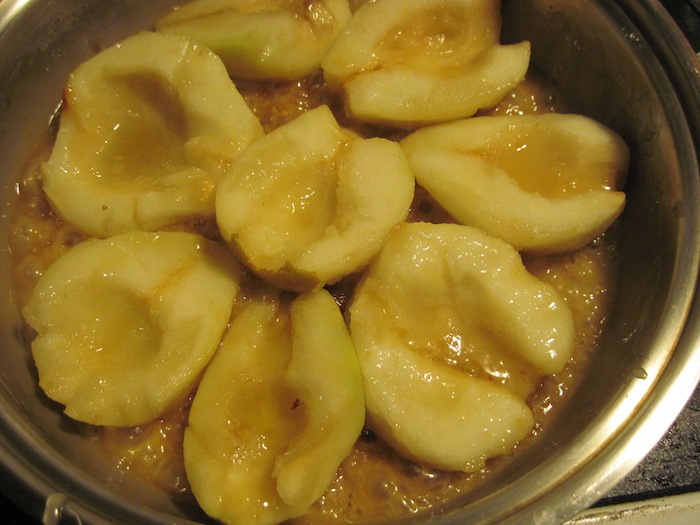
Boiling sugar before it begins to brown.  The pear on the right is awfully green.  It won't taste like much of anything, but it will make the tart look right, have the right proportions.

Rolled out pastry with a patch.

At this point I removed the pan from the heat.  The Comice is the larger halves.

Because you need before and after photos of the crust.

The brown juice on the edges?  Much of it spilled off the side of the plate when I inverted it from the pan to the plate.

Despite this, the tart, I suspect because of the Comice, was soggy.  But it looks good, don't you think?

Saturday, November 27, 2010

Thanksgiving is not a Great Art

This being a cooking blog, some sort of Thanksgiving post is probably expected. I was going to do one, actually, as I was planning on making pear-ginger tarte tatin. But the pears weren't ripe yet, so I made sweet potato pies again. The pies were good, but was there really anything to say about them? The scope of this blog has mostly only included deliberate experiments (or trying new recipes), and sometimes brief recipes of particularly good improvisations. But in fact "particularly good" is not at all the criterion for which improvised dishes or meals get written here and which don't. There are no criteria really, I just post when I feel like it. Some of the most well-remembered meals, usually those that were made to feed to my family, I never write down at all.

How are these statements connected?
"I'm very nervous when people talk about it as a great art."
"There's a lot to be said for mindless repetitive activity."
"It does not interest me if I'm not feeding people."
Well, Nigella Lawson said all of them. In the same interview she said she was unfazed "when How to Be a Domestic Goddess came out and I was railed against for being, you know, a traitor to the sisterhood, despite the fact that it was so obviously ironic."  Apparently Nigella expects we all share her level of self-consciousness in the nostalgia for domesticity she purveys.

Her story of how she started: when she was working as a journalist, she found space to think in the repetitive activities of cooking.  Making food, rather than a necessity, was in her story a psychological tool and a lifestyle choice.  Instead of feeding people because she's a housewife, she seems to self-consciously enjoy the fantasies that surrounded housewifery.  But obviously this is not the selfless fantasy of classic femininity.  One cooks for the pleasure of feeding, including the pleasure of feeding oneself.  One returns from an exhausting night of partying to make oneself bread pudding in the semidarkness of one's posh kitchen, and one eats it, alone, in bed.  If one is Nigella Lawson, one stages all this on camera and, I imagine, laughs about it.  What makes her so passionate about food, she is asked?  "I'm greedy."

This blog, on the other hand, is more about curiosity than greed or giving.  Although in trying new techniques and recipes, I often take part in a bit of both these pleasures.

Tuesday, November 23, 2010

Mrs. Hudson's Biscuits

I was warned that the results of the strange recipe given to me were equally strange. Two “strange”s in this limited vocabulary turns from “intriguing” to “bad.” So I tried making the much tastier-sounding (and looking) “Mrs. Hudson’s Biscuits” instead.

125 g. butter

125 g icing sugar

2 tsp vanilla sugar or 2 tsp sugar with 2-3 drops of vanilla extract

1 egg

1 pinch of salt

juice and grated peel of 1/2 lemon

125 g. flour

125 g. cornflour
1 knife tip baking powder

butter to grease pan

Glaze
100 g. icing sugar
2 tbsps lemon juice

Whip the butter until it is fluffy, then slowly add the icing sugar;
Add the vanilla sugar, egg, salt, lemon juice and peel;
Add the flour, baking powder and cornflour slowly and mix well;
Grease a baking tray with butter;
Fill a pastry bag with the dough and press small biscuits onto the baking tray;
Bake in a preheated 400F oven for 10-15 minutes
Make the glaze by mixing the icing sugar and lemon juice. Brush biscuits with it, and let it dry.
Makes about 70 biscuits.

Measuring flour.
Some of the quantities are in grams. The postage scale I use doesn’t have grams. Here are the quantities (roughly) in ounces:

4 1/2 oz butter (about one stick and another tablespoon)

4 1/2 oz icing sugar (somewhat more than a cup)
2 tsp vanilla sugar or 2 tsp sugar with 2-3 drops of vanilla extract

1 egg

1 pinch of salt
juice and grated peel of 1/2 lemon (I used the entire lemon’s zest)

4 1/2 oz flour (a little more than a cup)
4 1/2 oz cornflour (about a cup)

1 knife tip baking powder
butter to grease pan

Glaze
3 1/2 oz icing sugar

2 tbsps lemon juice (I just used all the juice from the other half)

The sad fate of my hand-folded pastry bag.
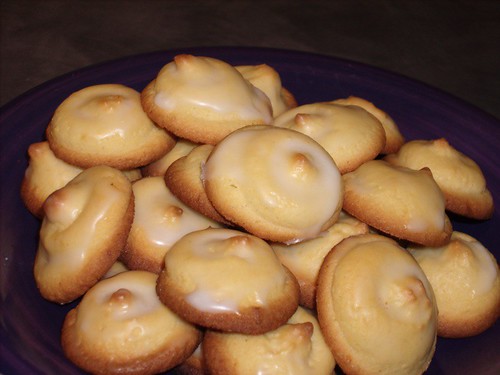
Two oopses flopped down as too-late realizations (I suppose that’s what an oops is) throughout the execution of this recipe. One, in my enthusiasm for not having to go to the store, I used course corn meal instead of corn flour. That there was a difference didn’t even occur to me until I crunched down on a bit of the dough. Two, I preheated the oven to 350 F instead of 400 F. The first batch was baked at 350 F for the first five minutes. There’s not quite a third--a mistake, but not an oops: I tried to make a pastry bag to create the neat little shapes pictured along with this recipe that sort of resemble breasts, but as you can see from the photo, it, well, broke. I used a spoon and my fingers instead. Oh well.

Melted butter and icing sugar.
And one other, that may not have mattered at all in the end: the recipe said to “whip the butter until it is fluffy.” Not quite knowing how to whip cold butter, I melted it. Mixing icing sugar into this makes for a somewhat disgusting-looking, greasy mess. But as long as the butter has chance to cool a bit before the dough is baked, I don’t think it makes a difference.

They may not be the most perfect replicas, but they’re quite nice. The lemon flavor is pleasingly strong. My descriptors are very reserved.

Sunday, November 21, 2010

Principles of Economy

A friend of mine found this strange recipe in The Sherlock Holmes cookbook: Or, Mrs. Hudson's storeside campanion formed upon principles of economy and adapted to the use of private families:

3 tbsp Butter
3/4 lb flour
6 oz sugar
1 grated lemon rind and lemon juice
2 eggs

Rub the butter into the flour; stir in the sugar and the lemon peel. When these ingredients are mixed, add the eggs and lemon juice. Beat the mixture well for a few minutes, then drop from a spoon onto a buttered baking sheet, about 2 inches apart. Bake the biscuits from 15-20 minutes in a moderate (350F) oven, until they lightly brown.


Who measures sugar by weight?  To me 6 oz seems like it isn't much at all.  The small amount of butter and sugar makes me want to classify these as a tea biscuit--something fairly bland but somewhat sweet.  But then there are the two eggs.  Two, for this little batch of dough?  They're bound to come out like dry, dense cakes (no rising agent here).  Who knows.

I doubt they'll look like these.
They appear to be a sorrier version of these very appetizing-looking "Mrs. Hudson's Biscuits."

Bored, and intrigued by the possibility that making these "biscuits" might surprise me, I think I'll make them tomorrow.  I'm tempted to take the literal approach and actually rub the butter with my fingers into the flour (something i've never done), rather than cut it in with a fork or a pastry blender.

Sweet Potato Pie II: Look look, pictures!

In reverse chronological order:

The second pie baked and fallen.

Just out of the oven, puffed.

Excess crust cut off with a knife.

Notice the spatula marks--the filling is thicker this time because I used more sweet potato but left the rest of the recipe unaltered from the first pie.

Lots of extra crust.

First pie baked.

Unbaked.  See?  This filling is much more liquid.


Prebaked crust.  I removed the weight for the last five minutes of baking.

Using not quite fully cooked sweet potato pieces as a weight to keep the crust from  becoming a balloon in the oven.

Boiling sweet potatoes.