Showing posts with label apples. Show all posts

Saturday, December 4, 2010

Something You Really Shouldn't Make, and Something Else, Which Requires The First

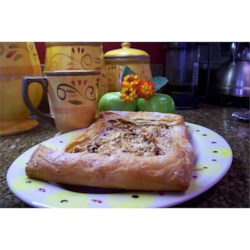
The photo I saw on allrecipes.
1. Looking for a way to use four granny smith apples, I was going to try to make "easy apple strudel," which more or less amounts to surrounding apple slices with puff pastry and baking it.  Unable to find puff pastry in the store, I bought phyllo dough instead, thinking that surely I could use this for something involving apples.  The something I stumbled into on allrecipes was also a "strudel," and seemed to function upon a principle of turning phyllo into puff pastry by layering butter between each sheet.  That, it turned out, was a very optimistic reading of the author's thought process.  Granted, I didn't follow the recipe exactly.  The gist seemed to be: layer about eight sheets of phyllo with melted butter in a pan, then put some apples, sugar, and whatever else you want on top of it, and then... and then what?  Here the text of the recipe says one thing, while the photo clearly shows something quite different.  The recipe reads "roll the sheets up to form a log shape."  The photo looks more like the edges were rolled up to prevent juices from spilling out.  For reasons somewhat murky to me, I went for the photo.  It occurs to me now that anyone can submit a photo for a recipe on allrecipes.  Food photography incites a strong mimetic impulse, but here the assumption that the photos accompanying a recipe come from the author's execution of the recipe, filling out the vagaries that the recipe's words have left, is wrong.  In this case the photo is of someone else's (mis)execution of the recipe.  Allrecipes is thus where a recipe's signified is set adrift.

The web 2.0 mechanism has wide limits, but of course there are plenty of other instances of dissonance between a recipe and its accompanying photography.  In those lavish coffee table cookbooks filled with beautiful photos that take up whole pages, the recipes often lack the finishing touches that made them look so good in the first place.  I have this Thai cookbook that mostly consists of photos of the countryside and its people living a far more aesthetic life than anyone possibly could.  In all the photos the dishes have these amazing garnishes, are placed on rustic tableware, and sometimes even contain ingredients that aren't in the recipe.  What draws me to make a particular recipe in the book is of course the photo, but not only is the recipe inadequate--it is impossible to recreate the photo unless you live in a fantasy version of Thailand.  In other words, rather than follow the recipe, you're better off going to a very upscale Thai restaurant in the US.  Yet if you do follow the recipe, it will be a medium through which to experience the photo.  Though you can see that your dish is not as it is pictured in the book, you taste the photo.

My version.
In the case of this "strudel," the photo fantasy backfired: tasting what I made didn't confirm that my version pales in comparison to the pictured, but rather it told me that what was pictured wasn't that great. It tasted about like it looked--okay.  The phyllo at the edges curled up and turned crunchy, which was mostly just annoying.  I ended up scraping most of the excess flakes off before putting a piece on a plate.    The bottom crust was far too tough, making it difficult to eat with a fork, as well as being an unpleasant texture.  The filling at least was nice: tangy, sweet, and cooked just right (the apples were neither mush nor crisp).

2. As a result of the above debacle, I now had a lot of browned phyllo flakes.  Rather than throw them away, I decided to turn them into a sort of bread pudding.  The pudding came out much better than the original "strudel" I think.  What follows is a very rough recipe, as I wasn't really measuring anything.

~2 cups phyllo flakes (I tore up some uncooked phyllo too)
2 eggs
~2/3 cup milk
~1/2 cup sugar
~2 tablespoons honey
~2 teaspoons cinnamon
~1 teaspoon nutmeg
a few drops of vanilla
~1 cup chopped almonds
~1/2 cup raisins

Preheat oven to 350 F.  In a bowl whisk together eggs, milk, sugar, honey (heat in a microwave first), cinnamon, nutmeg, and vanilla.  In a 8x8 baking pan, toss phyllo flakes, chopped almonds, and raisins.  Pour wet mixture over dry mixture.  Bake until the whole thing puffs up--maybe half an hour.
Tuesday, October 26, 2010

Tarte Tatin IV: Reproducibility

~10'' saucepan
4 Golden Delicious apples
1/2 cup honey
2/3 stick butter
1 tsp lemon juice
pastry dough enough to cover the ~10'' pan rolled

Preheat oven to 375 F.  On low heat, melt butter in saucepan.  Fill a large bowl about half way with water, and pour in lemon juice.  Peel, core, and quarter apples, placing them in lemon water.  When butter is melted, remove pan from heat and stir in honey, mixing thoroughly (a rubber spatula works to both stir and scrape honey out of a measuring cup).  Shaking off excess water, arrange apple quarters radially, exteriors up, in pan.  (Arranging the outside edge first is easier.)  Roll out pastry into a roughly round shape large enough to completely cover pan.  On high heat bring honey-butter to a boil.  Boil for 3 minutes.  Flip apple quarters. Boil for another 4 minutes, stirring apple quarters around but not messing up their arrangement (pushing the outside edge to spin it and moving the pan in a horizontal, circular motion are two ways to do this).  Remove from heat.  Move the rolled out pastry dough using rolling pin, and place evenly on top of pan.  Trim excess if there is a lot of it.  Using a utensil to avoid burning hands, gently tuck the edges down between apples and the edge of the pan.  Gently press the top into a relatively even shape.  Bake for ~30 minutes at 375 F.  Cool for ten minutes.  Run a knife along the inside edge of the pan.  Using potholders, turn out onto a plate.  Cool for another twenty minutes.

(No I'm not posting another pastry dough recipe.)

Sunday, October 24, 2010

Tarte Tatin III: Golden, Delicious, Boring

This time I used Golden Delicious apples.
Look, no applesauce!
4 apples, 6 minutes caramelizing, all-purpose flour.


Having put together a satisfactory result (I've replicated the more blonde photos that appear if you search for "Tarte Tatin" on Google Images), what would be the purpose of writing another recipe?  The trail-and-error experimentation I went through to arrive at this tasty yet now boring tart was not because of a dearth of good recipes, but rather because I had to get to know the recipe.  Apparently getting to know a recipe, for me, involves significant variations that are clearly not called for in the recipe: different fruit, sugar, flour, and proportions. (If stupidity is doing the same thing and expecting different result, what is doing something different and expecting the same result?)  It was through this daft variation that the necessities of the recipe revealed themselves.  Pears instead of apples and honey instead of sugar are fine.  But whole wheat pastry flour makes more finicky dough than all-purpose flour, the type of apples is dramatically important where consistency is concerned, and caramelization is a highly sensitive process that if you're niggly about burnt spots requires stirring, flipping, and paranoia about how long to leave the pan on high heat.  And so several seemingly unimportant details, glossed over by most recipes, become solidified into details that must happen.  If knowledge is as I have just described it, a collection of immobile things, perhaps this is why I am not at all motivated to write another recipe now that I think I know what I'm doing where this tart is concerned.  The previous recipe was in pursuit, and we've all heard those sayings about how it's all in the chase.  It was a recipe of what I imagined should be done, an imaginative fiction of sorts.  This recipe that I feel I should but don't want to write would be a history.  Although I would make some minor changes: I would caramelize it for just a little longer.  I would make sure there isn't a gap in the arrangement of apple slices.  I would use a little less water in the dough (the crust was a bit tough).  I suppose the point of writing the recipe down would be as an elaborate mimetic.  Months or years from now I will have forgotten about all this, and the recipe should allow me to make the same tart again, even though without the recipe I won't remember how.

Well, I still have one more round of dough in the fridge.  I'll write the recipe after I make one more tart.

Thursday, October 21, 2010

Tarte Tatin II: Applesauce

The bits that were too burnt are on that little plate in the background.
 I followed the recipe I wrote last time, but with apples instead of pears.  But they were Granny Smith apples, and so the result is very thick, sweetened, somewhat caramelized applesauce on top of pastry.  It doesn't taste bad, in fact it tastes very good, but the texture is not at all what I was hoping for.  Apparently I should be using a different kind of apple, one that doesn't disintegrate when baked.

Other problems included a hunk of pie dough very irritable from being left in the fridge for a few days.  Like a bad case of athlete's foot, it cracked over and over when rolled out, and it fell apart being gently tucked into the pan.  Its fragility was probably in part due to the whole wheat pastry flour.

Some parts of the top (the bottom) were virtually charcoal, which I remedied by just scraping them off.  But maybe I should move the apples around in the pan while they're cooking in the boiling caramel.

Finally, I think I liked the less fruit, more pastry of last time.