While I am not yet eating eggs with a comb out of a shoe, there is dog shit on the porch, mouse shit on the counter, a pile of week-old dishes soaking in putrid water in the sink behind which festers a crust of black mold, and grain moths hatching from and having their way with god knows what forgotten stash of dry goods. There’s no use denying it, I live in a house full of slobby men, and I am one of them. I flee from the mess I can’t stand.
The sight of the disgusting, somewhat toxic kitchen adds an unhealthy layer to my morning grumbling: I am loathe to cook anything, and for the first hour manage only to put the tea kettle on. On rare exuberant mornings I might wash some of the dishes while the water comes to a boil. Most of the time, though, I just pace around bemoaning the unendurable injustice of having to prepare and eat breakfast. This morning I stooped to a new low by making quesadillas for breakfast. They tasted largely of rubber and heartburn, but there wasn’t anything else around I could imagine being able to stomach.
After sitting in denial of my bodily needs in front of the computer with a cup of tea, reading new emails or perusing Google Reader for new amusements, most mornings I end up making pancakes. It is difficult to explain why I do this. I, and perhaps you, wouldn’t think that mixing together pancake batter from scratch is the solution for someone who wants non-nasty breakfast with minimal effort. Why not, say, cereal? It is the result of a collection of interconnected, deeply entrenched kitchen habits. I never think to buy cereal. I often buy yogurt, thinking that I’ll eat that in the morning, and I do, but it’s never enough to just eat yogurt. What else do we keep in the kitchen that’s palatable for breakfast? Well, there are eggs. Sometimes, there is bread, and when there is I make eggs on toast. But somehow, even though it is basically the same ingredients, fried eggs and buttered toast are more nauseating than pancakes. Also there is oatmeal, in my mind the least vomitable substance despite looking a bit like vomit, but I made the mistake of buying steel-cut oats. They are delicious, but take about half an hour to cook properly. I don’t get the normal, rolled variety because why buy those when I have the kind I will never use? Basically, I cook pancakes to not think about what to make for breakfast. They are the status quo.
And when the kitchen is disgusting, it is still somehow possible to scrape off whatever grime is on the cast iron pan and while it heats get out the pyrex measuring cup, crack an egg in, add milk, oil, flour, baking powder, and salt, mix it with a fork, and wait until the pan is hot. It’s a ritual that can happen amid squalor.
The result is a very starchy, tiring food. Eat a couple of pancakes and you may just want to go back to bed.
Having written this, maybe I should invest in some muesli.
Showing posts with label ew. Show all posts
Showing posts with label ew. Show all posts
Saturday, June 4, 2011

Friday, April 8, 2011
Sour, Spicy, Smokey Drumsticks

What such notions actually lead me to is standing lightheaded in front of the fridge, wanting something even mildly appealing to appear, and making myself sick with toast and butter. It is a terrible thing because not only is everything worse without food in the belly and sugar in the blood, but also in such a state it is impossible to think creatively about what to eat. Just give me something. Having fallen off the boat so to speak, I have been awash in endless Costco food items, which I choke down (whoops, there goes the ocean metaphor) in insufficient and nauseating quantities.
I realized that cooking for myself in a deliberate way is not an indulgence, it is a way to get myself to want and not just to need to eat. It keeps me in a stream of gustatory desire, so that I do not wither away in disgust. There is undoubtedly some psychological peculiarity belied by my need to control and be actively involved in the process of making food. But the point is, cooking is important, damn it!
And so we arrive at the last thing I cooked. It is in some way inspired by Adobo, which is not something I have ever made, and have only tasted once. Having been mostly distrustful of sourness in savory cooking, it is now a novelty that I want to explore.

4 chicken drumsticks
1/2 a medium cabbage
1 large onion
3 cloves garlic
3 small dried jalapenos
juice of 2 lemons
juice of 1 large orange
2 teaspoons smoked paprika
salt (1/2 teaspoon?)
Sprinkle salt on both sides of drumsticks. Cut cabbage half and onion into thin radial slices. Smash garlic cloves and chop into largish pieces. Chop dried japapenos into largish pieces. Juice lemons and orange and reserve juice. On high heat, heat oiled saucepan until oil begins to smoke. Being careful not to burn yourself, lay drumsticks in pan and cover with lid or towl to keep oil from splattering everywhere. Brown both sides (a few minutes on each side) of drumsticks and remove to a plate. Reduce heat to medium-low. Fry garlic and dried jalapenos for about ten seconds before adding cabbage and onion slices and stirring to coat everything in oil. Increase heat to medium and fry vegetables for five minutes, stirring every minute or two. Add chicken drumsticks, blanketing them under the vegetables. Add citrus juice and smoked paprika. Reduce heat to medium-low and cover. Cook for roughly half an hour, or until chicken is cooked all the way through. Salt to taste.
Tuesday, March 15, 2011
Caramelized Onion, Olive, and Mozzarella Tart

In the morning the cheese has hardened into a tough, dry scab. This tart has a very short shelf life; it lasts from the time it begins baking until it’s tasted. But I nibble on the caramelized onions, which never needed to be packaged and garnished at all.

Thursday, March 10, 2011
7th Annual Oregon Chocolate Festival
Booths, whether they are in a market or in an event, whether selling food, trinkets, or political causes, have always frightened me. I think this has to do with how supermarkets taught me to approach transactions. In a supermarket, the closest one comes to interacting with the seller is in the checkout line, and there the cashier hardly cares what one buys. I have a feeling of relative freedom in a supermarket because nobody is watching me, or at least only a very general someone. I am just one among many customers in the store at any given moment, and no employee is really in charge of the place; they just work there. In a small shop, on the other hand, I find myself running toward some secluded corner first, to collect myself before, if i have to, making the foray to where I can be seen. There is nothing keeping the employee or proprietor of a small shop from being interested in whatever I’m doing, even though, in all likelihood, they are not interested. Booths are the worst: everything I do can be seen, and we might even chat about it.
When I see booths I think of the two open markets that happen weekly in Ashland’s warmer months. Markets of this sort in the U.S. today are part of a more general trend of rejecting bits of postwar capitalism in favor of The Way Things Used to Be, or taking the Old World to the New. The boons of the 1950s have become the horrors of the new millennium: processed foods are bad, supermarkets distance us from our neighbors, agricultural technologies are poisonous. The list goes on, and each horror has given rise to a burgeoning alternative. Although some of them are more nostalgic museum pieces than anything else, these are all good things, I think. But even if the rigors of economics accept them, I’m not sure I entirely can. The mores of the supermarket have been encoded into my being.
So when I discovered that the chocolate tasting part of the Chocolate Festival consisted in visiting a bunch of chocolate vendor’s booths, I was scared. What was I to say? How was this interaction supposed to happen? How could I approach the booth without its occupants noticing? Would they be annoyed that I obviously wanted to eat their samples and nothing more?
I clung to the water spigot, downing draughts of ice water as if it were booze and I were drinking courage. Then I began walking around and around trying to work up the nerve to approach a booth. I was grateful for the vendors who, without preamble, thrust chocolatey things into my hands. Sometimes there were conversational spielers who asked me questions, brave souls. Not trusting my capacity to keep up my end of the talk, I would flee from these when first possible.
One time my flight led me up the hotel’s stairs, trying to distance myself from the festival, only to reencounter it. There was some sort of barely polite spat between a chocolatier, or maybe a chocolate company representative, saying that the Chocolate Festival screwed up the description of his company. Or something. Or it was put in the wrong category. Or he entered it into the wrong category, and thus lost the contest. Part of the Chocolate Festival is a judged chocolate contest. It’s a big hullaballoo, I imagine. He called the mistake “very embarrassing for me.” They argued for ten minutes, saying the same things over and over, while I sat on the stairs a floor above them. Nothing could be done, there was nothing he seemed to want or could want other than to let them know that they will never be forgiven. And the staff he was bitching at, in turn, could only apologize for their alleged error, and self-justify.
But down the stairs among the booths, any dissonance between chocolatiers and festival is invisible. In the end it is largely self-destructive to try to signal one’s dissatisfaction with the means of enunciation one is given. Although occasionally it can be quite lucrative.
Somehow, despite my skittishness, I managed to make my way to each booth. Well, I was guided through the gauntlet by a Chocolate Festival veteran. She said she has “plenty of taste but no standards.” This also describes my relationship with chocolate rather well. I am by no means a connoisseur, but some things I sampled at the festival, for whatever reason, I reacted viscerally to. Everything there tasted like chocolate--well, okay, the raw chocolate didn’t quite--but some things surprised me. Some of the most memorable bites follow.
There were the delightfully gooey, dark truffles from Branson’s Chocolates. I completely agree with their purveyor who said that’s how she likes ‘em, disdaining the stiff variety of truffles.
There was Lillie Belle Farms’gorgonzola chocolate spread. Contrary to their cute purple logo, they revel in trendy chocolate juxtapositions. There was chocolate with bacon, chocolate with tons of hot chili, and chocolate with local gorgonzola cheese. This last was like milk chocolate, but sharp with mold and saltiness.
Then we move on to the weird and the nonchocolate. Linda Shumate of PremRose Edibles was quite insistent on having everyone try her rose preserves. “It’s like eating rose water,” I said, which she seemed to find somewhat insulting. ”Which one?” I think she thought I was humoring her and that I hated the stuff, but actually I love it. It is a piece of high confectionary (or in the parlance of this blog, “pastry”) to simmer down enough rose petals to create a heavily perfumed preserve. Or whatever is done with the rose petals. I’m ignorant as to how it’s made. I imagine the arcane, perverse chemistry of “Perfume”.
Finally there was Zorba’s raw chocolate green tea ginger truffle, which is as much a mouthful in taste as its name. It was more than visceral. It eviscerated. Its green powdery coating puckered my mouth with intense bitterness. It tasted not of confectionary but of medicine, and made me feel like I had been given an inebriating dose of healthfulness. I felt dizzy. It was spectacularly awful.
There were a lot of raw chocolatiers at the festival. Jen Moore at the Jem Chocolates booth was chatty. “Have you ever experienced raw chocolate before?” she asked as I chewed on my sample. Of course. I should have guessed that one doesn’t have, taste, or try raw chocolate, one experiences it. She went on to tell me that raw chocolate is rich in nutrients. I blinked. Silly me, eating chocolate for pleasure. Roasting chocolate brings out the tannins she said, and hides the nuttiness of raw chocolate. She was one I eventually fled from. It turned out later that my ambivalence was as visible as I had feared. The second time I found myself there she said I (unwittingly) gave “good feedback.”
But I think, unlike booths, I dislike raw chocolate on principle. Every raw chocolatier seems to deal in the discourse of Truth. Processing and cooking chocolate corrupts its true healthful nature and noble flavor, turning it sour with tannins. I do find raw chocolate’s flavor refreshing in contrast to conventional chocolate’s intensity, but raw chocolatiers seem eager to take the word ‘raw’ literally and convince us that it’s better because it’s more real. Maybe I don’t understand because I just haven’t put enough effort into overcoming my entrenchment in industrial comforts. Maybe if I wrapped my head in hand-spun cloth, dressed entirely in Indian imports, renamed myself, and converted to Sikhism (in that order and not the reverse), I too would feel raw chocolate’s goodness.
When I see booths I think of the two open markets that happen weekly in Ashland’s warmer months. Markets of this sort in the U.S. today are part of a more general trend of rejecting bits of postwar capitalism in favor of The Way Things Used to Be, or taking the Old World to the New. The boons of the 1950s have become the horrors of the new millennium: processed foods are bad, supermarkets distance us from our neighbors, agricultural technologies are poisonous. The list goes on, and each horror has given rise to a burgeoning alternative. Although some of them are more nostalgic museum pieces than anything else, these are all good things, I think. But even if the rigors of economics accept them, I’m not sure I entirely can. The mores of the supermarket have been encoded into my being.
So when I discovered that the chocolate tasting part of the Chocolate Festival consisted in visiting a bunch of chocolate vendor’s booths, I was scared. What was I to say? How was this interaction supposed to happen? How could I approach the booth without its occupants noticing? Would they be annoyed that I obviously wanted to eat their samples and nothing more?
I clung to the water spigot, downing draughts of ice water as if it were booze and I were drinking courage. Then I began walking around and around trying to work up the nerve to approach a booth. I was grateful for the vendors who, without preamble, thrust chocolatey things into my hands. Sometimes there were conversational spielers who asked me questions, brave souls. Not trusting my capacity to keep up my end of the talk, I would flee from these when first possible.
One time my flight led me up the hotel’s stairs, trying to distance myself from the festival, only to reencounter it. There was some sort of barely polite spat between a chocolatier, or maybe a chocolate company representative, saying that the Chocolate Festival screwed up the description of his company. Or something. Or it was put in the wrong category. Or he entered it into the wrong category, and thus lost the contest. Part of the Chocolate Festival is a judged chocolate contest. It’s a big hullaballoo, I imagine. He called the mistake “very embarrassing for me.” They argued for ten minutes, saying the same things over and over, while I sat on the stairs a floor above them. Nothing could be done, there was nothing he seemed to want or could want other than to let them know that they will never be forgiven. And the staff he was bitching at, in turn, could only apologize for their alleged error, and self-justify.
But down the stairs among the booths, any dissonance between chocolatiers and festival is invisible. In the end it is largely self-destructive to try to signal one’s dissatisfaction with the means of enunciation one is given. Although occasionally it can be quite lucrative.
Somehow, despite my skittishness, I managed to make my way to each booth. Well, I was guided through the gauntlet by a Chocolate Festival veteran. She said she has “plenty of taste but no standards.” This also describes my relationship with chocolate rather well. I am by no means a connoisseur, but some things I sampled at the festival, for whatever reason, I reacted viscerally to. Everything there tasted like chocolate--well, okay, the raw chocolate didn’t quite--but some things surprised me. Some of the most memorable bites follow.
There were the delightfully gooey, dark truffles from Branson’s Chocolates. I completely agree with their purveyor who said that’s how she likes ‘em, disdaining the stiff variety of truffles.
There was Lillie Belle Farms’gorgonzola chocolate spread. Contrary to their cute purple logo, they revel in trendy chocolate juxtapositions. There was chocolate with bacon, chocolate with tons of hot chili, and chocolate with local gorgonzola cheese. This last was like milk chocolate, but sharp with mold and saltiness.
Then we move on to the weird and the nonchocolate. Linda Shumate of PremRose Edibles was quite insistent on having everyone try her rose preserves. “It’s like eating rose water,” I said, which she seemed to find somewhat insulting. ”Which one?” I think she thought I was humoring her and that I hated the stuff, but actually I love it. It is a piece of high confectionary (or in the parlance of this blog, “pastry”) to simmer down enough rose petals to create a heavily perfumed preserve. Or whatever is done with the rose petals. I’m ignorant as to how it’s made. I imagine the arcane, perverse chemistry of “Perfume”.
Finally there was Zorba’s raw chocolate green tea ginger truffle, which is as much a mouthful in taste as its name. It was more than visceral. It eviscerated. Its green powdery coating puckered my mouth with intense bitterness. It tasted not of confectionary but of medicine, and made me feel like I had been given an inebriating dose of healthfulness. I felt dizzy. It was spectacularly awful.
There were a lot of raw chocolatiers at the festival. Jen Moore at the Jem Chocolates booth was chatty. “Have you ever experienced raw chocolate before?” she asked as I chewed on my sample. Of course. I should have guessed that one doesn’t have, taste, or try raw chocolate, one experiences it. She went on to tell me that raw chocolate is rich in nutrients. I blinked. Silly me, eating chocolate for pleasure. Roasting chocolate brings out the tannins she said, and hides the nuttiness of raw chocolate. She was one I eventually fled from. It turned out later that my ambivalence was as visible as I had feared. The second time I found myself there she said I (unwittingly) gave “good feedback.”
But I think, unlike booths, I dislike raw chocolate on principle. Every raw chocolatier seems to deal in the discourse of Truth. Processing and cooking chocolate corrupts its true healthful nature and noble flavor, turning it sour with tannins. I do find raw chocolate’s flavor refreshing in contrast to conventional chocolate’s intensity, but raw chocolatiers seem eager to take the word ‘raw’ literally and convince us that it’s better because it’s more real. Maybe I don’t understand because I just haven’t put enough effort into overcoming my entrenchment in industrial comforts. Maybe if I wrapped my head in hand-spun cloth, dressed entirely in Indian imports, renamed myself, and converted to Sikhism (in that order and not the reverse), I too would feel raw chocolate’s goodness.
Friday, March 4, 2011
Soup of Leftovers and Throwing Stuff in the Oven


 Soup is probably the most well-trod way of using up leftovers. A lot of various things suddenly become commensurate when thrown in a pot of water or stock. I made soup of leftovers because I saw refried beans, fried kale, cooked ground beef, half an onion, a tortilla, and some mushrooms in the fridge, and I thought “soup!” And of course because it’s me, before any water came into the picture I browned onions, mushrooms, and garlic in some oil. And there was quite a bit of chili powder. And some possibly ill-advised cumin. (I couldn’t help but think of the overpowering odor of Rufus’s chili.) I know, these details outside of a recipe have you rapt, don’t they? Little did you know I’m trying to snuff you out in a blizzard of Irrelevant Facts.
 A tangent: I actually have no clue what I’m doing when it comes to seasonings. (Or, well, anything really, but seasonings especially.) I am either falling into strange habits, experimenting blindly, or being minimalist (salt, pepper). The thing is, I only understand how flavors go with other flavors in the negative. If I’m putting things together I’m thinking sure, I guess this might taste good together, maybe. But suggest to me a combination and often you’ll get a response of “ew,” or an extremely ill-masked dubious look. I apologize for this particular knee-jerk of mine.


Sorry, no recipe. Come on, you don’t really want a recipe for Soupy, Overcooked Pork Chops With Roasted Vegetable Topping, do you? There was once a time when this blog was about perfecting techniques and recipes. It has since devolved into me babbling about whatever the hell I feel like, sometimes connecting it to what I happened to have cooked recently. The defining change is that intentionality has left. I no longer cook things to post them on my blog. I cook what I cook, and sometimes take photos to keep the possibility of blogging about it open. In this case I forgot to take a photo of the roasted things, and instead you just get these photos of the uncooked ingredients arranged in the pan to go in the oven.


Tuesday, February 22, 2011
Pankeggs (and American Breakfasts)
The older I get, the more finicky I become about breakfast. Mostly I poke at it, trying my best to take seriously what only seems like an abstract need for food in the morning. The food often seems too rich, like it’s trying to feed me. Awfully presumptuous of it, don’t you think? Breakfasts in American restaurants are the most offensive in this regard. Their menus full of terrifying practicality, like every customer is in a state of emergency and has got to GET SOME FOOD IN THERE, stat. They don’t waste time on trivial things that aren’t dense with protein, fat, and carbohydrates. And they would never dream of skimping; they err on the side of making you explode. Don’t they understand that breakfast is a time of nausea? It’s in the name. Following a fast, one does not gorge oneself on bacon, eggs, butter, potatoes, and coffee. One might be very hungry, but one needs to ease into the fact of eating. One needs to be seduced. The purveyors of American breakfasts seem completely ignorant of the erotics of eating. To consider the mediative process by which food gets from plate to stomach would be, what, too French?
(I know, I just romanticized Frenchness. Sigh.)
Nonetheless, this morning I made pankegg. It’s one of those gimmicky breakfast foods that fuses a fried egg with some starchy substrate. Actually I can only think of two such foods: egg-in-a-hole and pankegg. Yeah, alright, so maybe it’s not a whole genre.


(I know, I just romanticized Frenchness. Sigh.)
Nonetheless, this morning I made pankegg. It’s one of those gimmicky breakfast foods that fuses a fried egg with some starchy substrate. Actually I can only think of two such foods: egg-in-a-hole and pankegg. Yeah, alright, so maybe it’s not a whole genre.
Pancakes
1 egg
~3/4 cup milk
2/3 cup whole wheat pastry flour
2 teaspoons vegetable oil
pinch of salt
1 teaspoon baking powder
Pankeggs
3 more eggs, one for each pancake
In a medium bowl combine egg, milk, and oil. Add flour, baking powder, and salt. Thoroughly whisk everything together. Let stand for five minutes while the pan heats on medium heat.
Oil the pan. Pour pancake onto pan. When there are lots of bubbles, remove it to a plate, uncooked side up. Crack an egg into the center of the pan. Immediately place the pancake on top of this, uncooked side down. Cook for a few minutes, so that the yolk in still runny. Serve egg side up. Repeat for remainder of pancake batter (should make 3).
1 egg
~3/4 cup milk
2/3 cup whole wheat pastry flour
2 teaspoons vegetable oil
pinch of salt
1 teaspoon baking powder
Pankeggs
3 more eggs, one for each pancake
In a medium bowl combine egg, milk, and oil. Add flour, baking powder, and salt. Thoroughly whisk everything together. Let stand for five minutes while the pan heats on medium heat.
Oil the pan. Pour pancake onto pan. When there are lots of bubbles, remove it to a plate, uncooked side up. Crack an egg into the center of the pan. Immediately place the pancake on top of this, uncooked side down. Cook for a few minutes, so that the yolk in still runny. Serve egg side up. Repeat for remainder of pancake batter (should make 3).
 |
| Match cut to the second to last photo? |
 |
| There isn't roughly 3/4 cup milk like the recipe says. I just fill the measuring cup to the 1 cup mark. |


 |
| Tierra del Pancake-o |
 |
| It's true, taking this photo allowed the egg to cook for too long without the pancake. I'm sure it was cold and alone for those ten seconds. |
 |
| Pregnant pancake! |
 |
| Little known fact: eggs scream at frequencies we can't hear. |
 |
| Ugh. |
Monday, February 14, 2011
Mickey the Milk Man
It has been pointed out to me that I am often appalled by food. For someone who writes a blog about food I have remarkably little enthusiasm for eating. I push away my plate, content more with the freedom from having to eat I have just won. Eating is often merely a distasteful means to an end. Maybe this is because I read In The Night Kitchen over and over as a child. Or perhaps I read it over and over because in some way it spoke to my tendency toward disgust. In either case the book is certainly related in some way.
There is actually a convincing case to be made for the latter possibility that I have always been prone to rejecting food. As a very small child, I am told (I don’t remember this), I went so far as to pick the bowl off of my highchair and throw it at my parents. They were the oppressors who had introduced this cruel new economy into my life: to survive you must eat. I rejected it as a theory for as long it was possible to do so. The doctor worried. My parents worried and, hoping that the problem was merely an uncontrollable enthusiasm for throwing food at them, bought a bowl with suction cups. Somehow, I managed to throw this new bowl at them too. Their idea of why I did this remained unchallenged. But today I am convinced that I did not just take pleasure in throwing things at them (though I’m sure I did). I think that I was appalled by the notion that this stuff in the bowl had to go into my mouth, and moreover that I had to make it do so. No more were the good old days of breastfeeding and bottles. I’m sure I’m getting the chronology wrong somehow, but after a rather extended period of drinking from a bottle, I chucked it into a trashcan myself, in a symbolic gesture full of melodrama. I didn’t know at the time what I had just gotten myself into. My will to self-determination was propped up by the idea that beyond the bottle lay not just dignity, but freedom. Nobody ever told me that I would have to eat.
In a way my childhood fast is the very height of heroism, and in its extremity reveals heroism’s absurdity. Here is heroism: one stands between a reality and a truth and throws a fit. I would deal with primal loss by viewing the world with skepticism and occasionally denying its vicissitudes altogether. I would not accept eating as my access to the good stuff. No, it was just some new shit.
Mickey of In The Night Kitchen has a much less problematic relationship with, um, milk.
 Among other things, In the Night Kitchen is the story of Mickey's nakedness.
 Mickey falls into the night kitchen under a mistaken identity: milk. Yes, that is his hand.
 Mickey asserts his identity, his separateness from the night kitchen and its ingredients. He is not a part of their mad cake production. He is not milk. He is special. Or at least he certainly has no doubts that he is.
Despite his protestations the bakers still take him for milk, and for this reason chase after him.
 At this point he has transformed as if by magic two foods into tools for his use: a jumpsuit from the cake he was baked in, and an airplane from unbaked dough with which to evade the bakers. The bakers in fact form no real threat. He is the master, almost effortlessly shaping all the world to his will.
 Refuting that he is milk, he goes to get milk. This is the story, then, of the formation of Mickey's masculine subject-position. I daresay it's not a coincidence that the bottle of milk is an enormous phallus and the tallest building.
 But to get milk and yet be separate from milk he must form a new relationship with the milk. Rather than being confused for milk, he and the milk interpenetrate. Distinction is just another word for friction. Interestingly he and the book celebrate this moment. To have rather than to be might necessitate objects circulating through you, but it's not a price. It's a kind of glory, it seems.
The milk, it is worth noting, dissolves his cake-clothing. Getting the milk demands nakedness.


There is actually a convincing case to be made for the latter possibility that I have always been prone to rejecting food. As a very small child, I am told (I don’t remember this), I went so far as to pick the bowl off of my highchair and throw it at my parents. They were the oppressors who had introduced this cruel new economy into my life: to survive you must eat. I rejected it as a theory for as long it was possible to do so. The doctor worried. My parents worried and, hoping that the problem was merely an uncontrollable enthusiasm for throwing food at them, bought a bowl with suction cups. Somehow, I managed to throw this new bowl at them too. Their idea of why I did this remained unchallenged. But today I am convinced that I did not just take pleasure in throwing things at them (though I’m sure I did). I think that I was appalled by the notion that this stuff in the bowl had to go into my mouth, and moreover that I had to make it do so. No more were the good old days of breastfeeding and bottles. I’m sure I’m getting the chronology wrong somehow, but after a rather extended period of drinking from a bottle, I chucked it into a trashcan myself, in a symbolic gesture full of melodrama. I didn’t know at the time what I had just gotten myself into. My will to self-determination was propped up by the idea that beyond the bottle lay not just dignity, but freedom. Nobody ever told me that I would have to eat.
In a way my childhood fast is the very height of heroism, and in its extremity reveals heroism’s absurdity. Here is heroism: one stands between a reality and a truth and throws a fit. I would deal with primal loss by viewing the world with skepticism and occasionally denying its vicissitudes altogether. I would not accept eating as my access to the good stuff. No, it was just some new shit.
Mickey of In The Night Kitchen has a much less problematic relationship with, um, milk.


Despite his protestations the bakers still take him for milk, and for this reason chase after him.


The milk, it is worth noting, dissolves his cake-clothing. Getting the milk demands nakedness.

Mission accomplished. Mickey relishes in his newly forged identity: he gets milk.
This is the only red text in the book.

He is restored from nakedness to the regular world and clothedness, but now a boy. His identity is from the night kitchen is not lost, but reflected: oh to ho. He shares this secret joke with himself.
Perhaps I liked the book so much because it offered a new, exciting possibility for my relationship with things that come in bottles. Maybe I threw away my bottle in hopes of becoming Mickey, the perfect boy.
Friday, January 28, 2011
Quinoa with Tomato-Bacon-Beet-Spinach Sauce

I might even say, in one of the more postmodern gustatory aesthetics, that good food causes such renewing sensory rupture. Of course, ideally it does so more subtly than by blaring a neon red siren in your face and then handing you a plate of tomato sauce. Comfort food, on the other hand, strives toward a mimetic reproduction of your preconceptions. There can never really be, but comfort food may accomodate. What we have in this opposition of comfort and "good" is an appallingly bad account of what makes food good. Food full of the unexpected and disjunctive may still be bad, mediocre, nauseating, or even inedible. And comfort food also may be all of these things. This is not a way of evaluating the goodness of food, but a way of defining differing aesthetic modes. "Good" and "comfort" might be better termed "high" and "low."
What brought me here? Beets. The color of one of the oldest vegetables jars me into having to convince myself that tomatoes and bacon in fact taste like tomatoes and bacon. It has such an effect, I think, because it reminds me of blood--fake blood, and therefore of the permeability of bodily boundaries. We have become used to putting substances in our mouths and swallowing them. In fact, depending on the account of childhood psychological development you subscribe to, there may never have been a time when we were not used to it. Nonetheless we generally have come to think of the process of eating as not at all at odds with being contained within our bodies. Voiding waste is only slightly more threatening to this sealed bodily conception. But as much as straight male psychology at some unconscious level depends on rejecting it entirely, there is no avoiding it: things enter us and exit us through multiple orifices, including us. And blood, although generally this only exits. But from the plate in front of me deep red sauce enters.

1 small red beet
2 cloves garlic
7 medium frozen tomatoes
3 strips bacon
handful or two baby spinach
juice of 1/4 lemon
3 teaspoons dried basil
1 teaspoon dried oregano
1/4 teaspoon black peppersalt to taste (1/2 teaspoon?)

Sunday, January 23, 2011
Inedibles: Beet Cake and Boiled Turnip

I began composing this entry before I made the beet cake. Specifically I planned to write that I began composing the entry before I baked or ate the beet cake that the entry was to be about. I was supposed to then connect this fact to the idea that I tasted the cake before I tasted it--an idea I have been developing (or perhaps only reiterating) in recent entries. But instead the real cake completely collapsed the cake I had imagined (in addition to itself physically collapsing). It went against my expectations in the most extreme way. I couldn’t even manage to eat more than a bite.
 |
| The photo from When Mia Cooks |


Earlier I wrote of beets as an antithesis to taste in relation. I treated beets as a taste singularity around which language strains to find adequate comparisons. What happens when a singularity is baked into a cake? It intervenes.
When I was carrying them home, the beets stained a library book I had in the same bag. One more beet just fell out of my bag. I had no idea it was still there, lurking.

 I feel obligated to describe how the turnip was inedible. I’ll go about this in a roundabout way by describing the anxieties that the guide to cooking turnips I found online gave me. While not explicitly saying so, the guide gave the impression that the turnip is a toxic vegetable, similar to, say, cassava. It warned that “turnips tend to have a bitter flavor if not boiled long enough, with at least ONE water change (usually two)!!” I had to extract the bitterness from them by changing the water, twice? Moreover for larger (and therefore more bitter) turnips “it is best to cook them uncovered so the bitter gasses can escape.” They have gasses? What was I trying to do, exorcise a possessed vegetable? If so I was not successful. The cooked turnip smelled nice, but I could not stomach it. It was not an immediate bitterness; it twisted slowly in my mouth, making all food distasteful for the rest of the evening. It was something evil. But I’m willing to believe that the evil can be more completely beaten out the turnip, if not entirely, and that the result would be tasty.
It turns out this was not an entry concerned with the ontology of inedibles. Instead I wrote a great deal about how the inedibles were cooked, and how they tasted. Their specific visceralness blinds me to the social construction of inedibility waiting just beyond the immediate “ew.”
* Except on one occasion.
Friday, January 21, 2011
To write this blog is to find new ways of describing how food is disgusting.
I hate cooking. Have I mentioned that? Also I want to do nothing but cook.
On the one hand, the need to eat is an obstacle to the rest of life. I don't want to have to eat. But I'm always eating to preempt hunger--not so much a a desire to eat as a visceral awareness that I need to eat. Hastily and begrudgingly I try to fill myself with adequate food so that I can get on with life. Can’t I get this over with?
Most mornings all I really want is tea. I want to have my time with tea, or I should say of tea: it is supposed to pull me out of time’s regular flow into tea time. Tea is in this way a kind of pastry. However tea is in reality never enjoyable by itself. One has to be enjoying something else--to be enveloped by, focused on, or occupied by something else for tea time to happen (or not happen) at all, if it does. Usually, lacking in some other enjoyment, tea time really is no time at all, in the wrong way. It passes quickly, bringing me almost immediately to tepid sloshings of acrid, camel liquid--then out of (in the sense of having run out) but very much in time and out of tea. So, dispassionataely, I cook breakfast out of necessity. This is how I hate cooking.
On the other hand I want the same impossible thing from cooking that I want from tea. I want to escape through cooking. I want the process to be involving enough that I forget everything else. I want a kind of productivity for which there is no need. The taste of the results, really, is not all that important.
Biscotti are dry, crumbly, tasteless things. Hunks of stuff to have with coffee. By themselves they are blah. Good coffee has a slight aroma of shit. This is an incomplete metaphor that doesn’t work; it doesn’t just leave a slight trace behind, it leaves whole swaths fallow.
One can’t not eat, and one can’t only cook--then one would be a cook, and would have to get one’s jollies elsewhere.
On the one hand, the need to eat is an obstacle to the rest of life. I don't want to have to eat. But I'm always eating to preempt hunger--not so much a a desire to eat as a visceral awareness that I need to eat. Hastily and begrudgingly I try to fill myself with adequate food so that I can get on with life. Can’t I get this over with?
Most mornings all I really want is tea. I want to have my time with tea, or I should say of tea: it is supposed to pull me out of time’s regular flow into tea time. Tea is in this way a kind of pastry. However tea is in reality never enjoyable by itself. One has to be enjoying something else--to be enveloped by, focused on, or occupied by something else for tea time to happen (or not happen) at all, if it does. Usually, lacking in some other enjoyment, tea time really is no time at all, in the wrong way. It passes quickly, bringing me almost immediately to tepid sloshings of acrid, camel liquid--then out of (in the sense of having run out) but very much in time and out of tea. So, dispassionataely, I cook breakfast out of necessity. This is how I hate cooking.
On the other hand I want the same impossible thing from cooking that I want from tea. I want to escape through cooking. I want the process to be involving enough that I forget everything else. I want a kind of productivity for which there is no need. The taste of the results, really, is not all that important.
Biscotti are dry, crumbly, tasteless things. Hunks of stuff to have with coffee. By themselves they are blah. Good coffee has a slight aroma of shit. This is an incomplete metaphor that doesn’t work; it doesn’t just leave a slight trace behind, it leaves whole swaths fallow.
One can’t not eat, and one can’t only cook--then one would be a cook, and would have to get one’s jollies elsewhere.
Tuesday, January 18, 2011
Inadvisable Meal II: Beets & Sausage

In short, beets should be tempered with other things. Do not eat a pile of beets with beet sauce. A pile of beets with sausage covered in beet sauce is not much of an improvement.
In elementary school I knew this Jehovah's Witness who loved beets. In the cafeteria he would sit down with a huge helping of ruffle-cut beets on his tray, lustily spearing them with his fork and turning his bulging lips red by slurping them into his clumsy mouth. "Oh, I love beets," he would say. We would all grimace in disgust. Some would try to make fun of him, but he would just laugh and flash back an evil, self-contented smile between chomps. Somehow I always liked him. No harm could touch him. He had become a beet, staining everything and impossible to stain. The dye of beets is the only true substance. A beet may be eaten, but its color persists and travels through you, eventually ending up in the ocean. How the oceans are not a deep magenta is beyond me.
I had planned to write this in the morning, but tonight beets have kept me up writing about beets. The beet has disrupted my plans and it smirks. Pastry may be sorcery, but the beet is something much older, purer, and more insidious. Root vegetables are coming into vogue like never before. It is the age of roots, and the beet is rising.
I am sick of beets. Perhaps I should make a beet cake, or a beet pie.
 3 medium beets: 1 red, 1 yellow, 1 white & pink
1/4 of a lemon
4 peppercorns
1/2 teaspoon salt
1 tablespoon olive oil
3 teaspoons flour
Peel beets and chop into bite-sized pieces ~1cm thick. In a large saucepan bring 2 cups of water to boil, and add beets Squeeze juice from lemon quarter and drop the whole thing in the pan. Add peppercorns and salt. Lower heat to medium-high and cover. Boil for about 50 minutes, adding more water if necessary and stirring beets every fifteen minutes or so. When beets are soft, remove them with a slotted spoon to a large bowl. Lower heat to medium-low. Add olive oil to liquid. Sprinkle flour gradually while whisking liquid. Remove from heat. Pour sauce over meat accompaniment.
Saturday, January 15, 2011
Rockfish Salad
 |
| Shit, I didn't take a photo and I've run out of fish. Oh well, isn't this rockfish adorable? The photo was taken by Joyce Feuerbacher Altgelt, apparently. |
Without further ado, here is a recipe for an undesirable salad that came about in peculiar circumstances.
2-3 large handfulls salad greens
~1/2 cup cooked rockfish
8 kalamata olives
1/2 tablespoon balsamic vinegar
1/2 tablespoon olive oil
1/2 teaspoon black pepper
1/4 teaspoon salt
1 teaspoon honey
In a large bowl place salad greens. Tear olives in half into salad. Tear bite-sized pieces of rockfish into salad. Drizzle balsamic vinegar, olive oil, and honey over salad. Sprinkle salt and pepper over salad. Write one more sentence that ends in "salad," just in case your readers missed that everything was going into the salad.
~1/2 cup cooked rockfish
8 kalamata olives
1/2 tablespoon balsamic vinegar
1/2 tablespoon olive oil
1/2 teaspoon black pepper
1/4 teaspoon salt
1 teaspoon honey
In a large bowl place salad greens. Tear olives in half into salad. Tear bite-sized pieces of rockfish into salad. Drizzle balsamic vinegar, olive oil, and honey over salad. Sprinkle salt and pepper over salad. Write one more sentence that ends in "salad," just in case your readers missed that everything was going into the salad.
Sunday, December 19, 2010
Mrs. Hudson's Biscuits II: Hiding Behind Photography

 |
| There has got to be a better way to spread this into a circle. |
This time I spread the dough in a round pie pan, baking it as a sort of giant cookie, and then slicing into eighths once it was glazed and cooled. Which admittedly makes far larger biscuits than called for.
It's only the texture I'm iffy about--the flavors of lemon and corn go well together I think.
Why did I try this in the first place? Because the photos looked nice. Now I've taken an appetizing (I think) photo, in a different way, of more or less the same thing. If this weren't such an oddity, the world might be full of mouth-watering photos of it. Culinary hobbyists' kitchens everywhere would pop out these sunny-looking treats. The texture I've described as displeasing might instead be the subject of a poetics of delicacy. Like chocolate, a few strange people would never like it, much to the confusion and even mild distrust of everyone else. Or maybe not. There's more to gastronomic phenomena than photography.
What did the gelatinous goodies of the 1950s taste like? And I don't mean "what would they taste like if we made them today and tried them?"
Thursday, December 16, 2010
a nasty concoction
I used to
sneak into their kitchen
at night to concoct
an ineffectual remedy
for an intangible ailment
warm milk
chamomile
nutmeg
vanilla
I used two
spoons of honey
sneak into their kitchen
at night to concoct
an ineffectual remedy
for an intangible ailment
warm milk
chamomile
nutmeg
vanilla
I used two
spoons of honey
Saturday, December 4, 2010
Something You Really Shouldn't Make, and Something Else, Which Requires The First
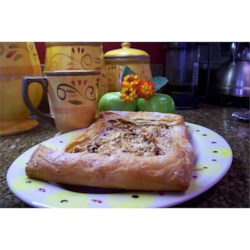 |
| The photo I saw on allrecipes. |
The web 2.0 mechanism has wide limits, but of course there are plenty of other instances of dissonance between a recipe and its accompanying photography. In those lavish coffee table cookbooks filled with beautiful photos that take up whole pages, the recipes often lack the finishing touches that made them look so good in the first place. I have this Thai cookbook that mostly consists of photos of the countryside and its people living a far more aesthetic life than anyone possibly could. In all the photos the dishes have these amazing garnishes, are placed on rustic tableware, and sometimes even contain ingredients that aren't in the recipe. What draws me to make a particular recipe in the book is of course the photo, but not only is the recipe inadequate--it is impossible to recreate the photo unless you live in a fantasy version of Thailand. In other words, rather than follow the recipe, you're better off going to a very upscale Thai restaurant in the US. Yet if you do follow the recipe, it will be a medium through which to experience the photo. Though you can see that your dish is not as it is pictured in the book, you taste the photo.
 |
| My version. |
2. As a result of the above debacle, I now had a lot of browned phyllo flakes. Rather than throw them away, I decided to turn them into a sort of bread pudding. The pudding came out much better than the original "strudel" I think. What follows is a very rough recipe, as I wasn't really measuring anything.

2 eggs
~2/3 cup milk
~1/2 cup sugar
~2 tablespoons honey
~2 teaspoons cinnamon
~1 teaspoon nutmeg
a few drops of vanilla
~1 cup chopped almonds
~1/2 cup raisins
Preheat oven to 350 F. In a bowl whisk together eggs, milk, sugar, honey (heat in a microwave first), cinnamon, nutmeg, and vanilla. In a 8x8 baking pan, toss phyllo flakes, chopped almonds, and raisins. Pour wet mixture over dry mixture. Bake until the whole thing puffs up--maybe half an hour.
Thursday, October 15, 2009
ham tea
1 tablespoon spoiled milk
1 tablespoon sugar
2 cups water
1 tea bag
boil water
pour water into cup with tea bag
cover for a minute
take out tea bag
add sugar and spoiled milk
stir
"why does this tea smell like ham?"
1 tablespoon sugar
2 cups water
1 tea bag
boil water
pour water into cup with tea bag
cover for a minute
take out tea bag
add sugar and spoiled milk
stir
"why does this tea smell like ham?"
Subscribe to:
Posts (Atom)
