Showing posts with label pie. Show all posts

Monday, March 21, 2011

Caramelized Onion Tart

3 large onions
3 tablespoons olive oil
pinch of salt
1/4 teaspoon ground black pepper
1 tablespoon brown sugar
1 tablespoon lemon juice
1 tablespoon tamari
2 tablespoons water
1 unbaked tart shell

Slice onions radially into slices roughly 1/2 inch wide at their widest point. In a large saucepan on medium-high heat, fry onions with olive oil, brown sugar, salt, and black pepper. Mix to coat onions with oil. Stir and scrape pan every few minutes, allowing the onions to brown between stirring. After roughly ten minutes reduce heat to medium. After roughly another twenty minutes reduce heat to medium-low. It's not important to be exact about these timings; the important thing is to have the heat at such a point that it deeply browns but does not quite blacken the onions. As the onions brown and reduce, they burn more easily. When they're mostly dark brown, add lemon juice, tamari, and water, and scrape pan thoroughly with spatula to deglaze. Remove from heat. Spread caramelized onions evenly in tart shell. Bake at 400 F for ~30min.

Friday, March 18, 2011

A Particularly Rough Day in the Life of a Saucepan

Sometimes, I wish I could taste. Almost every day I'm filled with substances that my owners find flavorful. And sometimes I imagine what it would be like to be them. But I know that it is their place to taste, and mine to hold and to heat. Well, no, I don't actually heat--something else heats me and I heat the things my owners eat.

I have my good days, and I have my bad days. It's hard to know which are which. There are the days I luxuriate in the darkness of the cupboard, and days I reach a several hundred degrees, containing fireworks of oil and water within my walls. Of course, there are those times I'm left in the sink filled with grime and water for hours or days.

Today was nuts. I was not in the sink an hour before being scraped clean in a rush and thrown back onto the heat. It takes some time for me to warm up. My owner threw slabs of butter onto my surface, and I turned them to golden puddles. I don't normally melt butter at this temperature. It was bit invigorating. Sugar weighed down on me. This is why I'm made of metal, and not, say, paper. A paste of sugar and butter scraped me like sand as he mixed it. But it takes something much worse than sugar to actually scratch me.

There were apples, too. It all became molten soon enough. Wet apples clung to my surface and, cringing, I burnt them. At such moments I feel a pang of regret and anger at myself or at my owner, I can't say which. It is his neglect but my flesh. I got the feeling he was being especially negligent today, because rather than carefully maintaining the arrangement of apple pieces held within me, the spatula was flung every which way as he mixed them into a messy pile. Beside me I heard the frantic motions of a rolling pin. It did not take long for the molten sugar to begin to burn. There is something in the way it bubbles that gives it away. Atop me he threw brown scraps of dough like the ad-hoc furs of some barbarian. Most of the gaps were closed before I was thrown in the oven.

Waiting in the oven is different than the usual kinds of waiting I do--waiting in the cupboard, waiting in the sink--because, like him outside in the kitchen, I am anticipating being removed from the oven. In the cupboard and in the sink I don't get so anxious because I know I could be there for a long time. I'm never in the oven for very long, though I never know exactly how long. I keep wondering if the crust is browned enough, if he will be satisfied with how the crust looks. He opened the oven at least a dozen times during my stint in the oven this time.

When he finally did take me out, he ran a knife along my walls, as he usually does, to detach the crust. I do wish he would find a better way to flip me over. It makes me nervous being spun about like that, although honestly at some level I hope he does slip, drop everything including me (I'm metal, I can take it), and spill burning tart all over him. But yet again, he didn't. He did burn himself on my handle though. I suppose you could say I burned him. But really, he should've known better. I wonder why he's so clumsy today.

Like I said, just a quick scrub and I was put back at it.


As the ripping sounds of vegetables being sliced apart reverberated through my metal curvature, I became increasingly hot. Oil slipped across me, pooling on one side. This is why I have walls. My owner dropped the sliced vegetables onto me, and I made them sizzle. I could feel them slumping and sweating against me. What does a shallot taste like? A heap of broccoli interrupted my speculations. He didn't let the shallots develop their flavor, he was hasty. He usually leaves onions, which are similar enough to shallots, sauteeing for much longer. He was acting strangely.

The vinegar and olive brine barely touched me, becoming puffs of steam on contact. He covered me up, trapping clouds in my interior. Water collected in droplets inside my cover, and streamed down the sides. More water was splashed in from a cup, and more. Vapour spat out my sides.

The flour he sprinkled in just turned to tiny lumps. My task was basically done, then just a container into which more was dumped: shrimp, salt, pasta. For a moment he slides me back onto the heat, but takes me off again. That's it. I've been left in the fridge ever since. I'm used to waiting.

Tuesday, March 15, 2011

Caramelized Onion, Olive, and Mozzarella Tart

This tart went from whatever to tantalizing to whatever. I wanted to make it because I wanted to write a blog post about it. But I soon became interested in the process of making it although I was not particularly looking forward to the result. Chopping and cooking the onions helped me think; the world became spacious with the sound of frying onions. But I was not salivating yet. That happened when I put the assembled tart in the oven. I wanted to eat it. I rejoiced: this was an achievement. Was it as good as I anticipated? No, not really. Too much of too thick of a still somewhat doughy crust. The whole thing was just ridiculously heavy, and I thought the cheese actually detracted from the caramelized onions. And I’m not sure the olives were necessary. If I made this again I would use four onions instead of two for the same size tart, I would not use whole wheat pastry flour in the crust (I ran out of all-purpose flour), and I would not add olives or mozzarella. And wine might be a nice addition. Or something else a little fruity. Maybe tomatoes, or even apples.

In the morning the cheese has hardened into a tough, dry scab. This tart has a very short shelf life; it lasts from the time it begins baking until it’s tasted. But I nibble on the caramelized onions, which never needed to be packaged and garnished at all.

Thursday, January 6, 2011

Bakewell Tart

Ever since I ran across this video & recipe I've developed an instant righteousness about Bakewell Tart.  Nobody has ever heard of it around here.  The injustice!  I keep having to explain what it is.  My explanations being what they are (stunted, reluctant, and full of 'err's), I settled upon this one: it's basically butter, almonds, and sugar in a pie crust with a bit of raspberry jam.  This seems to simultaneously please and put people on edge.  Unless of course they have an faddish, ironic adoration of fat, in which case they pronounce the absurdly rich tart "awesome."  Why did I sweeten to this tart so quickly?  Because it's British, of course.  And how!  The infinitesimal amount of fruit present is in the form of jam and buried beneath a vast stratum of stiff, buttery whiteness.

My version is flecked with brown because I couldn't find the recommended blanched almonds.  Instead I just put some raw almonds in the food processor.  I have to say if you consider the crust a given, this is one the easiest tarts ever.  Mix ground almonds, butter, sugar, and eggs together.  Spread the crust with raspberry jam.  Spread the almond mixture evenly on top of that, and bake it well.  I'm waiting for the rotten fruit to hit me for that one.

Adapted from Elaine Lemm and Smitten Kitchen

1 baked tart shell or pie crust
1 1/2 sticks butter
3/4 cup white sugar
2 large eggs and one yolk
1/2 cups almonds
zest of one lemon
1/2 teaspoon almond extract
2 tablespoons raspberry jam

Preheat oven to 350 F.  Warm butter until soft but not liquid.  In a large mixing bowl cream butter and sugar together.  Whisk in eggs, yolk, lemon zest, and almond extract.  In a food processor grind almonds thoroughly but not into a paste (i.e. don't turn it into almond butter).  Mix ground almonds into the butter/egg/sugar mixture.  Spread raspberry jam on the bottom of the tart shell or pie crust.  Spread filling evenly on top of raspberry jam.  Bake for 50 minutes.

Friday, December 31, 2010

Oh my buttons!


In The Mill on the Floss, Tom explains to Maggie why he will not be running away the next day.  “It’s the pudden,” he confides, “I know what the pudden’s to be--apricot roll-up--oh my buttons!”  I’ve never heard of a roll-up before except of course those strips of candied fruit puree that kids used to (do they still?) have in paper-bag lunches called “fruit roll-ups.”  I assume this is a pastry.  It sounds very appealing, but more appealing to a not especially wealthy nineteenth-century English family who only ever has such things on special occasions than to my contemporary palate.  Apricot roll-up, ever since I read that sentence, has taken on a vibrant and uncertain life in my imagination.  I keep thinking of the words nd of why Tom is oh-my-buttonsing about it.  Incommensurate images float unresolved in my mind.  How is it rolled up?  It is made from fresh, dried, or otherwise preserved apricots?  What kind of pastry dough are they rolled up in: pate brisee, pate sablee, puff pastry, yeasted dough, or something else?  What is apricot roll-up?  At this point a google search would not answer the question I’m trying to ask.  I don’t want to know what it was historically, what George Eliot may have been referring to.  Because I don’t know what it is I have begun to imagine something.  I want to know what that something is, and in what ways it might be brought into the world.

Or maybe, considering what I did recently bake, I don’t want to make it tangible at all, and I’m content letting it draw me toward baked semblances.  After making pear-ginger tarte tatin and sweet potato pie for Christmas, I still had some pie dough leftover in the fridge.  Thinking of apricot roll-up, I rolled the remaining dough into a roughly rectangular sheet, covered it in thin pear slices, sprinkled it with brown sugar, cinnamon, and nutmeg, rolled it up and baked it at 400 F.  Well, fifteen minutes in I became paranoid that it wouldn’t become properly crisp and turned it up to 425 F.  Also I tried to pucker the ends together to keep the juices from running out too much.  The juices did run out and burned to a black caramel at the bottom of the pan, but I liked it.  It was a roll-up.  The nice thing about a culinary fantasy defined by a single word with little semantic grounding is that it can be many things.

I was also pleased because this pear roll-up was made from things that just happened to be around.  Probably derived from the frugality endorsed by environmentalism and an ego-aspiration to quiet resourcefulness, this is also one of my foremost culinary desires.

Like the sweet potato pie of last entry, I liked it because of what I thought I was making as well as because it, I thought, tasted good.  Some vagueness or polyvalence in what I imagine I’m making seems to be a necessary part of this equation.  Taste is again mediated by fantasy, but instead of the enticing photos I referred to as enthralling (as in actually placing me in their thrall) motivators to make Mrs. Hudson’s Biscuits, tarte tatin, and apple strudel, this came of a written phrase.  Why do I romanticize the textual seed of this fantasy, and hold the photographic distastefully between thumb and pinky?


1 small round pate brisee
1 large pear
4 tablespoons brown sugar
1 1/2 teaspoons cinnamon
1/2 teaspoon nutmeg

Roll out pate brisee into a rectangle roughly twice as long as it is wide.  Halve and core pear.  Slice pear thinly.  Lay pear slices parallel to the shorter edge in two rows.  Sprinkle brown sugar, cinnamon, and nutmeg over pear slices.  Roll from short side to short side.  Pinch together the open ends of the roll.  Place roll in a baking pan with the seam facing up.  Bake at 425 F for about half an hour, or until the crust turns golden brown.

Monday, December 27, 2010

Taste


What makes a good tarte tatin? Going by the polite compliments of those who consumed the pear-ginger tarte tatin I made for Christmas dinner, my quibbles are excessive. Soggy crust does not matter. The way the butter rose to the top to form an off-white opacity does not matter. Hell, those things didn’t matter to me, either. I only wanted there to be more of it. Yet a sense of culinary aesthetics demands that the pears should not be laying in a pool of liquid when the tart is turned out onto a dish. (Maybe this could be avoided by using sugar instead of honey.)

There is also a sense that the making makes the dish, a conflation of the process with the result. The logic goes if I’m pleased with the pears boiling in honey--if it looks good, if it smells good--then the tart is good. This also goes for the sweet potato pie I made the same day. I liked its color (a bilious drab green), and what went into it. The light spices, the light sweetening of honey, the light color of the Japanese yam flesh, the thickness of the pie all came together in an aestheticism that had nothing to do with taste and yet constitutes a great part of taste. When I tasted it, it was the beauty of the process I was wishing for.

This is why it is necessary but impossible to separate taste from aesthetics, pleasure from ideas. Necessary because taste does not come of itself, and impossible for the same reason.

I might account for my former enthusiasm for the dozens of dense, eggy spice cakes by remembering my enjoyment of what went into them. There was a subtle balancing art of ingredients and spices that went into these cakes that was impossible to discern in the finished product unless you were me. It was possible for me to taste some hidden nobility in the cake despite the consistency which I could somehow deny. More likely I only now, several years later, remember them as dense and disgusting, and at the time there were not other possibilities that I knew of.

In honor of the cooking process’s interiority (if not the cook’s) rather than its ultimate appearance as taste to the world, the accompanying photos are of pear peels, pears boiling in honey, and unbaked sweet potato pie.

Excuse me.  Instead of "in honor of," the paragraph above should begin "to exploit," much like speeches that "honor" the dead.


Monday, November 29, 2010

Picture Show: Soggy Pear-Ginger Tarte Tatin


Three D'Anjou (one of which is unripe), and one Comice.  More a compulsion than a desire for the end result.

Ginger in butter.  Ginger was not something I wanted to taste in the tart at this point.  It didn't smell right.  Adding it to the tart was just something I wanted to do.

Boiling sugar before it begins to brown.  The pear on the right is awfully green.  It won't taste like much of anything, but it will make the tart look right, have the right proportions.

Rolled out pastry with a patch.

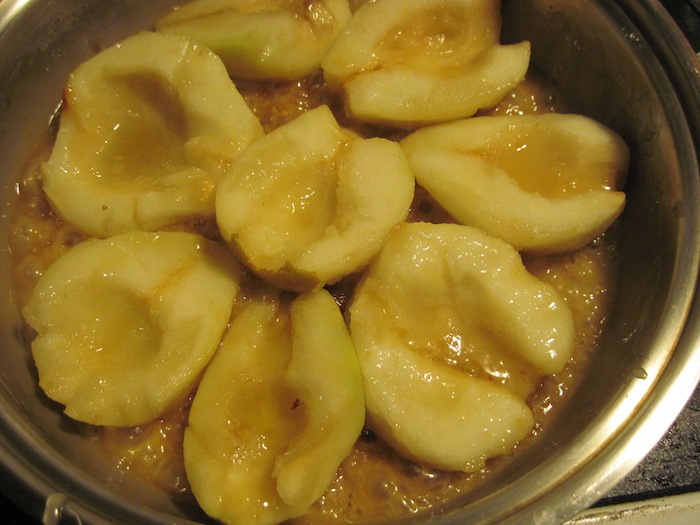
At this point I removed the pan from the heat.  The Comice is the larger halves.

Because you need before and after photos of the crust.

The brown juice on the edges?  Much of it spilled off the side of the plate when I inverted it from the pan to the plate.

Despite this, the tart, I suspect because of the Comice, was soggy.  But it looks good, don't you think?

Sunday, November 21, 2010

Sweet Potato Pie II: Look look, pictures!

In reverse chronological order:

The second pie baked and fallen.

Just out of the oven, puffed.

Excess crust cut off with a knife.

Notice the spatula marks--the filling is thicker this time because I used more sweet potato but left the rest of the recipe unaltered from the first pie.

Lots of extra crust.

First pie baked.

Unbaked.  See?  This filling is much more liquid.


Prebaked crust.  I removed the weight for the last five minutes of baking.

Using not quite fully cooked sweet potato pieces as a weight to keep the crust from  becoming a balloon in the oven.

Boiling sweet potatoes.

Saturday, November 20, 2010

Sweet Potato Pie

I made sweet potato pie.  I followed the recipe from the first google hit for "sweet potato pie," with some alterations.

Is this worth writing about?

I made some very broad statements in the last post, as I'm wont to do.  While I was making the crust for the pie, I kept having to look back at the recipe I adapted from Helen Rennie to remember quantities.  Despite making pastry dough many times, I needed that recipe.  Or at least I needed its list of quantities.  The recipe is not disposable.  It's a kind of helper--somewhere to defer my memory.  It's an instance of a cliche of how the internet has changed the nature of knowledge: it's not so important if one remembers everything, so long as one knows where to look.  In the case of recipes however, the internet is not necessary at all--encyclopedic cookbooks have been serving as cyborg extensions of memory for a long time.

So I don't need to know how to make pastry dough.  I wrote it here in this blog.  The blog remembers how.  To return to my question, is this worth writing, let's compare this to my diaries.  I have boxes and boxes of diaries.  Most of them I have read at least twice.  Reading them is at once familiar and surprising--on the one hand, reading them triggers memories and I might also recall writing what I wrote, on the other, I had, up until reading it, forgotten much if not all of what I wrote.  One is almost always remembering in one way or another, but there is obviously nothing cumulative about it.  Reading a diary doesn't add to a collection of things I remember, but puts me in a different stream of remembering.  Through reading the diary some memories come to life again--I think about them again briefly, they might crop up over and over for a long time.  In other words, the diary must be read, and reading happens in time.  Having "saved" (the anxiety of losing memories drove much of my diary writing) these memories in a diary, only in the unread text of the diary might they be saved.  Only without a reader might the text be said to exist as a totality.  But not really, of course--it isn't anything without being read, is it?

But this blog is not a diary.  I'm not trying to record the ephemera of experience here.  A recipe is simply supposed to record a procedure in a way that's followable.  Actually this isn't so simple, as I've discussed before.  And thankfully.  Wouldn't it be awfully dull if even just a recipe could be written in the universal register?  This suggests another purpose for a recipe: to not be quite followable.  Not that a recipe writer has to try to do this, but a recipe's potential to confuse, mystify, or unintentionally inspire might be valued.  Because apparently I need to subject recipes to the literary theories of decades ago.

The pie was good.  The crust I thought was a bit too hard, although someone else liked it, called it "crunchy."  I prebaked the crust for fifteen minutes or so before filling it, using the sweet potato pieces in tinfoil as a weight to keep the crust from puffing up.  Improvising a weight was the most enjoyable part.  Next time however I'll just fill the unbaked crust, so that the crust turns out softer.

Tuesday, October 26, 2010

Tarte Tatin IV: Reproducibility

~10'' saucepan
4 Golden Delicious apples
1/2 cup honey
2/3 stick butter
1 tsp lemon juice
pastry dough enough to cover the ~10'' pan rolled

Preheat oven to 375 F.  On low heat, melt butter in saucepan.  Fill a large bowl about half way with water, and pour in lemon juice.  Peel, core, and quarter apples, placing them in lemon water.  When butter is melted, remove pan from heat and stir in honey, mixing thoroughly (a rubber spatula works to both stir and scrape honey out of a measuring cup).  Shaking off excess water, arrange apple quarters radially, exteriors up, in pan.  (Arranging the outside edge first is easier.)  Roll out pastry into a roughly round shape large enough to completely cover pan.  On high heat bring honey-butter to a boil.  Boil for 3 minutes.  Flip apple quarters. Boil for another 4 minutes, stirring apple quarters around but not messing up their arrangement (pushing the outside edge to spin it and moving the pan in a horizontal, circular motion are two ways to do this).  Remove from heat.  Move the rolled out pastry dough using rolling pin, and place evenly on top of pan.  Trim excess if there is a lot of it.  Using a utensil to avoid burning hands, gently tuck the edges down between apples and the edge of the pan.  Gently press the top into a relatively even shape.  Bake for ~30 minutes at 375 F.  Cool for ten minutes.  Run a knife along the inside edge of the pan.  Using potholders, turn out onto a plate.  Cool for another twenty minutes.

(No I'm not posting another pastry dough recipe.)

Sunday, October 24, 2010

Tarte Tatin III: Golden, Delicious, Boring

This time I used Golden Delicious apples.
Look, no applesauce!
4 apples, 6 minutes caramelizing, all-purpose flour.


Having put together a satisfactory result (I've replicated the more blonde photos that appear if you search for "Tarte Tatin" on Google Images), what would be the purpose of writing another recipe?  The trail-and-error experimentation I went through to arrive at this tasty yet now boring tart was not because of a dearth of good recipes, but rather because I had to get to know the recipe.  Apparently getting to know a recipe, for me, involves significant variations that are clearly not called for in the recipe: different fruit, sugar, flour, and proportions. (If stupidity is doing the same thing and expecting different result, what is doing something different and expecting the same result?)  It was through this daft variation that the necessities of the recipe revealed themselves.  Pears instead of apples and honey instead of sugar are fine.  But whole wheat pastry flour makes more finicky dough than all-purpose flour, the type of apples is dramatically important where consistency is concerned, and caramelization is a highly sensitive process that if you're niggly about burnt spots requires stirring, flipping, and paranoia about how long to leave the pan on high heat.  And so several seemingly unimportant details, glossed over by most recipes, become solidified into details that must happen.  If knowledge is as I have just described it, a collection of immobile things, perhaps this is why I am not at all motivated to write another recipe now that I think I know what I'm doing where this tart is concerned.  The previous recipe was in pursuit, and we've all heard those sayings about how it's all in the chase.  It was a recipe of what I imagined should be done, an imaginative fiction of sorts.  This recipe that I feel I should but don't want to write would be a history.  Although I would make some minor changes: I would caramelize it for just a little longer.  I would make sure there isn't a gap in the arrangement of apple slices.  I would use a little less water in the dough (the crust was a bit tough).  I suppose the point of writing the recipe down would be as an elaborate mimetic.  Months or years from now I will have forgotten about all this, and the recipe should allow me to make the same tart again, even though without the recipe I won't remember how.

Well, I still have one more round of dough in the fridge.  I'll write the recipe after I make one more tart.

Thursday, October 21, 2010

Tarte Tatin II: Applesauce

The bits that were too burnt are on that little plate in the background.
 I followed the recipe I wrote last time, but with apples instead of pears.  But they were Granny Smith apples, and so the result is very thick, sweetened, somewhat caramelized applesauce on top of pastry.  It doesn't taste bad, in fact it tastes very good, but the texture is not at all what I was hoping for.  Apparently I should be using a different kind of apple, one that doesn't disintegrate when baked.

Other problems included a hunk of pie dough very irritable from being left in the fridge for a few days.  Like a bad case of athlete's foot, it cracked over and over when rolled out, and it fell apart being gently tucked into the pan.  Its fragility was probably in part due to the whole wheat pastry flour.

Some parts of the top (the bottom) were virtually charcoal, which I remedied by just scraping them off.  But maybe I should move the apples around in the pan while they're cooking in the boiling caramel.

Finally, I think I liked the less fruit, more pastry of last time.

Tuesday, October 19, 2010

Pear-Honey Tarte Tatin

Having just watched, I don't remember why, someone who is apparently not Jamie Oliver make Tarte Tatin, I stared at three pears waiting to rot in the fridge, and had a mad idea.  I think, in retrospect, I was more enamored with the madness than the idea itself (not that there is such a thing): make Tarte Tatin with these pears, but use honey for the caramel (there's no sugar in the house).  If this is "madness" my life must be terribly mundane.  It became apparent when I started peeling the pears that every recipe I had read used enough fruit to fill the pan completely, sometimes layering more on top.  Julia Child's pan, the extreme case, is brimming over.  So it would be a scant tart.

For a recipe I followed the "filling" part from smitten kitchen's, and (roughly) Helen Rennie's extremely explicit pastry technique.  Except I halved smitten kitchen's recipe, because I was only using half the amount of fruit, I used ~1/3 cup honey instead of 1/2 cup sugar, and for the crust whole wheat pastry flour, which is not as heavy as whole wheat flour, but does taste like something and has some texture. 

The problem, I think, with using honey is that it caramelizes more quickly than sugar.  So while smitten kitchen's recipe called for cooking the caramel with fruit for ten minutes on high heat, after five minutes I was afraid I had ruined the whole mess, and then I only cooked it for another minute or two after flipping the pear halves over.  And even then, I think it came out just a little too burnt.

Oops, I didn't cut the edges free from the pan before turning it out.
But despite being maybe a little too caramelized, and not terribly pretty, it was still delicious.  I made enough dough for another, maybe next time I'll try apples--more than three, even.

What follows is the untested recipe I would follow if I were to make this again.
Pastry (for two tarts)
13.5 oz (~3 cups) whole wheat pastry flour
2 1/2 sticks butter
1 tsp salt
2 tsp sugar
1 cup ice water

With a postage scale, weigh a medium bowl, and then subtract this weight to weigh 13.5 oz flour in it.  Set this aside, and put the sugar and salt on top of it.  Cut the (cold) butter into lengthwise quarters and then many chunks (~1cm square).  Scatter these on a plate and put in the freezer for ten minutes.  Move the flour with salt and sugar to a food processor.  Put in the butter chunks.  Pulse repeatedly until the butter is cut into pea-size or smaller pieces.  While pulsing every second or two, slowly pour 1/2 cup ice-cold water.  Pick up some dough with your hand and squeeze it.  If it holds together easily, not falling apart after you stop squeezing, it's enough water.  If it falls apart, add more water in small increments until it does hold together.  Dump half of the not-yet-formed dough mixture out onto a flat, clean surface, scrape it together into one mass (despite the paranoia of heat that accompanies pastry dough, I think your hands are fine as a scraping instrument), and squeeze into a ball.  Do the same with the other half of the unformed dough mixture.  Seal with plastic (a bag, or plastic wrap) and refrigerate.


Fruit
6 pears
3/4 cup honey
1 stick butter

Preheat oven to 375 F.  Peel, halve, and core pears.  Splash a little lemon juice on top of them.  Melt butter on low heat in a large saucepan that can be put into the oven (no plastic parts).  Remove from heat, and stir in honey with a whisk.  Arrange pears facing down (they will be flipped).  Cut pear halves into pear quarters to fill in gaps.  While it's cooking, roll out pastry dough into something that will more than cover the top of the pan.  Cook on high heat for 3 or 4 minutes.  Flip pears.  Cook for another 2 minutes.  Roll the flat dough onto a rolling pin or other cylindrical object, to make transferring it onto the pan easier.  Lay it on top of the pan.  Push the edges into the sides of the pan, where possible between the pears and the sides of the pan.  Bake in the oven for about 30 minutes.  When the crust is just barely browned, take it out.  Let it cool for 30 minutes.  Unstick the edges of the crust from the sides of the pan with a knife.  Place a plate (significantly larger than the pan if possible) on top of the pan.  Using pot holders on both hands holding the pan and the plate together, quickly flip them over so that the tart falls onto the plate.

Tuesday, September 29, 2009

Not Quite Lorraine


But quiche nonetheless.

crust, adapted:
one stick butter
one and a half cup whole wheat pastry flour
half teaspoon salt
one teaspoon sugar
half cup cold water or less

Preheat oven to 400F. Put together flour, salt, and sugar in a large bowl. Using flour as a way to keep butter from being slippery, cut stick of butter into small cubes (~1cm square) and distribute into flour. Cut butter into flour (in lieu of a pastry cutter, a fork will work with some finger pain). Add cold water a tablespoon at a time until it's possible to smash the dry clumps into a ball of dough with your hands. Sprinkle some flour liberally on a flat surface. Use this area to roll ball of dough into a disk large enough to lay on top of your pie dish plus a couple inches. While you're rolling dough keep it from sticking by flipping over and sprinkling more flour on each side. Lay dough disk into pie dish and push it around to conform to the shape of the dish. Cut off excess if you want (eat it!). Poke the bottom of it with a fork a few times. Bake until dry but not browned or hardened. It will bubble when baked--this is generally a big no-no, countered by weighing down the dough with heavy objects in a bag, but you're not cooking this crust hard, so the bubbles should be pressed back down by the liquid of the filling. Or they won't. I'm lazy.

filling, adapted:
half an onion
four crimini mushrooms
quarter stick butter
one cup grated swiss cheese
four eggs
two cups heavy cream
one teaspoon salt
a pinch sugar
half teaspoon cayenne pepper
half teaspoon paprika

Preheat oven to to 425 F. Chop onion into 1cm square pieces. Slice mushrooms in half and then into thin slices. Melt butter in a small frying pan and fry onions and mushrooms on medium-low heat until onions are translucent. Remove from heat. In a large bowl mix together thoroughly eggs, cream, salt, and sugar. Grate cheese into crust. Transfer onions and mushrooms into crust. Pour egg and cream mixture on top of this. Muss it about with a spoon to avoid a heap of cheese in the middle. Sprinkle cayenne pepper and paprika on top. Bake until top becomes somewhat browned.